
The World Economic Forum has named passive radiative cooling materials one of its Top 10 Emerging Technologies of 2026. The report was released at the 17th Summer Davos meeting (the Annual Meeting of the New Champions) in Dalian, Liaoning, and lists the technologies it sees as most likely to reshape industries over the next five years. For a technology that cools surfaces with no electricity at all, it is a significant moment.
Why the WEF picked passive radiative cooling
This year’s meeting was held under the theme of innovation at scale and brought together more than 1,700 participants from over 90 countries and regions to discuss new paths for global economic growth. The report notes a shift: after years of an AI wave centred on software, transformative technologies are moving off the screen and into the physical systems that support the modern economy, namely energy, medicine, food and materials.
Passive radiative cooling materials are a leading example of that shift. They tackle a physical problem, heat, with a physical answer, and they do it without drawing on the power grid. The report expects the technology to help address global challenges in energy and the environment and to influence policy and industry over the next five years.
What is passive radiative cooling?
The principle is simpler than it sounds. Careful optical design gives the material two key functions:
- High solar reflectance: it reflects most of the sun’s heat back to the sky.
- Efficient thermal emission: it radiates heat as infrared radiation through the atmospheric window, the 8 to 13 μm band in which the air is largely transparent, so the heat escapes straight to space.
The whole process uses no electricity and runs entirely passively. It is a zero-energy way to cool. Our guides to radiative cooling paint and radiative cooling film go deeper into the physics and the test data.
Why the 8 to 13 μm window matters
Every warm surface gives off heat as infrared light. Most of that light is absorbed by water vapour and carbon dioxide in the air, which send part of it back down, so an ordinary roof cannot shed much heat to the sky. Between 8 and 13 μm the atmosphere is largely transparent. Heat emitted in this band passes through the air and escapes to space, which is close to absolute zero. A surface that emits strongly in this band can therefore cool itself, and on a clear night it can drop below the temperature of the surrounding air.
Why solar reflectance has to be so high
The cooling effect is small compared with the sun. Under a clear midday sky, sunlight delivers around 1,000 W to each square metre of roof, while a radiative cooling surface sheds up to about 100 W/m². A surface that absorbs even 10% of the sunlight loses its whole cooling effect. That is why the reflectance figure matters so much, and why our paint reflects at least 90% of sunlight and our film at least 95%. Ordinary white paint usually reflects less and absorbs part of the ultraviolet and near-infrared light, so it still warms up in the sun.
How it differs from ordinary white paint
| Approach | Reflects sunlight | Sheds stored heat to space | Needs power |
|---|---|---|---|
| Air conditioning | No | No, moves heat elsewhere | Yes |
| Ordinary white or reflective paint | Partly | Limited | No |
| Passive radiative cooling materials | Yes, most of the solar spectrum | Yes, through the 8 to 13 μm window | No |
Proven in real applications
Field use backs up the WEF’s view. An academic study found that a radiative cooling coating lowered the outer roof surface temperature of a telecom base station by about 20.8 °C, smoothed out indoor temperature swings, and cut the air conditioner’s daily electricity use by about 10%.
Our own projects point the same way. In a 30-day side-by-side test, our paint and film kept a telecom cabinet’s surface about 19 °C cooler on average. Read the full telecom cabinet case study.
From the report to real projects
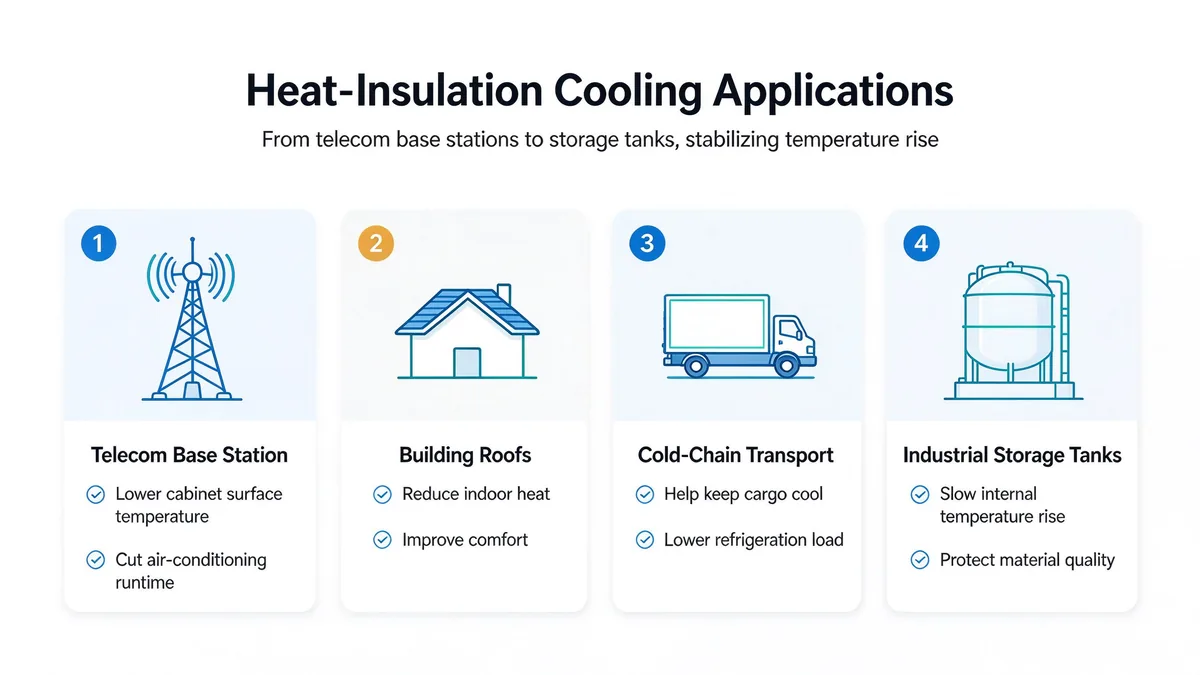
While the WEF lists passive radiative cooling as a frontier technology, we have already turned it into products made at industrial scale. Our radiative cooling paint and radiative cooling film are developed in-house on this technology route and are already in use across several sectors:
- Telecom base stations: lower cabinet surface temperatures and shorter air conditioner run times.
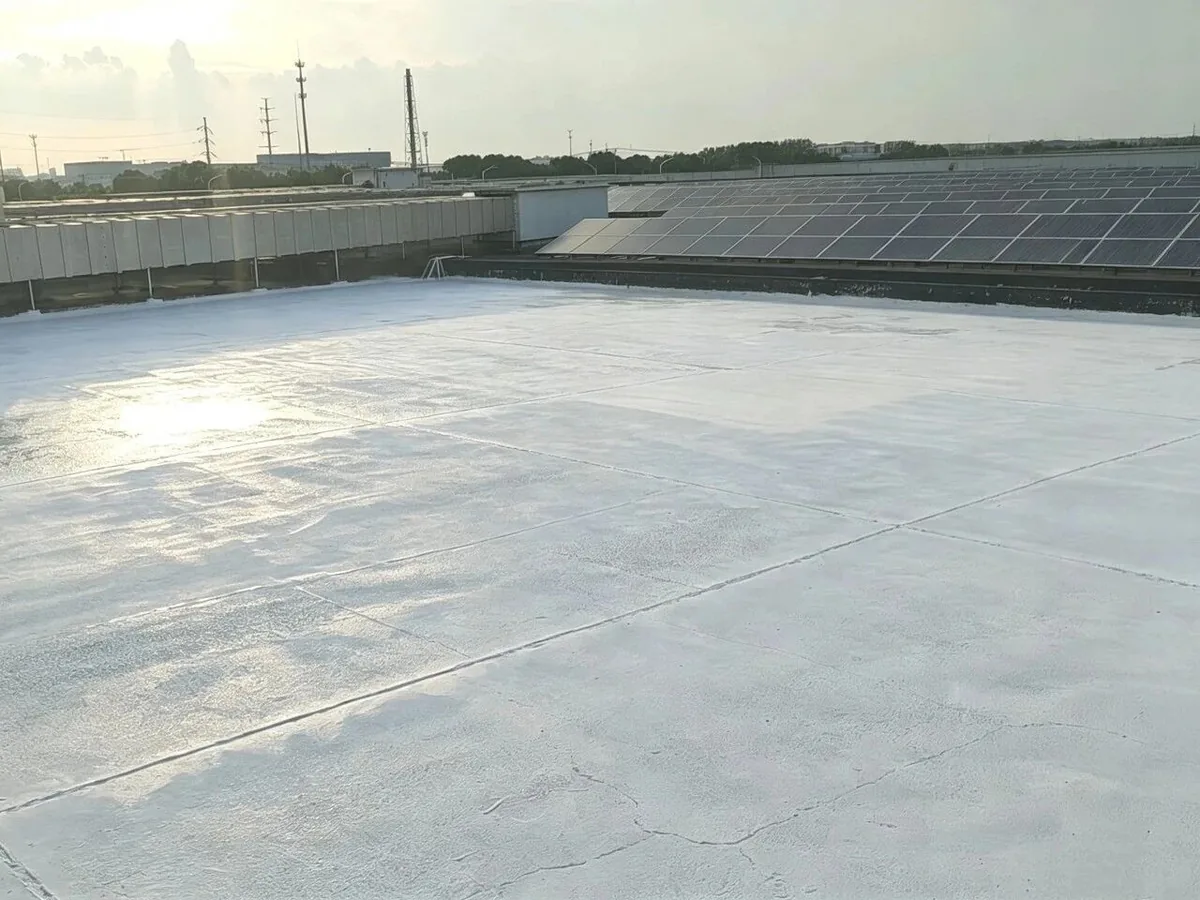
- Building roofs: less heat entering the building and better indoor comfort. See our cold storage roof project.
- Cold chain transport: cooler cargo boxes and a lower refrigeration load. See the refrigerated truck test results.
- Industrial storage tanks: slower temperature rise inside and better protection of stored materials.
Key data for our two products:
| Property | Paint | Film |
|---|---|---|
| Solar reflectance | ≥ 0.90 | ≥ 0.95 |
| Emissivity (8 to 13 μm) | ≥ 0.90 | ≥ 0.90 |
| Best suited to | Walls, cabinets, tanks and shaped surfaces | Roofs and large flat surfaces |
What our radiative cooling paint and film are made of
The paint system
Our radiative cooling paint is water-based and goes on by spray or roller as a three-layer system:
- Primer, about 100 μm. A two-component primer bonds the system to the surface: a transparent epoxy primer on concrete and buildings, or an anti-corrosion sealing primer on metal.
- Radiative cooling coating, two coats of about 400 to 500 μm in total. This layer reflects sunlight and emits heat in the 8 to 13 μm band.
- Weather-resistant topcoat, up to about 80 μm. It protects the cooling layer and helps rain wash dust off, which keeps the surface white.
Because it is applied wet, the paint follows cabinets, pipes, tank shells and other shaped surfaces, and it can go on while the equipment stays in use.
The film
Our radiative cooling film comes in rolls and is laid on large flat or gently sloped surfaces such as roofs. It works from -60 °C to +80 °C and is made to the QB/T 5970-2023 standard. It is available in several versions:
- A butyl-adhesive version that also serves as a roof waterproofing membrane
- A version on a non-woven base for projects that need extra thickness
- Film laminated directly onto steel sheet for colour-steel roofs
- A magnetic-backed version that sticks straight onto steel for faster installation
Frequently asked questions
What did the WEF say about passive radiative cooling?
Its Top 10 Emerging Technologies of 2026 report lists passive radiative cooling materials among the technologies most likely to reshape industries in the next five years, and expects them to help address energy and environmental challenges.
Is passive radiative cooling already available?
Yes. Our radiative cooling paint and film are made at industrial scale and already used on telecom base stations, building roofs, cold chain transport and storage tanks.
Does it work on cloudy days and at night?
It works around the clock with no power. The effect is strongest under clear skies and weakens in cloudy or rainy weather, because clouds partly block the 8 to 13 μm atmospheric window.
Bringing a top-10 technology to your site
The WEF’s recognition confirms the value of passive radiative cooling. We will keep investing in the research and application of radiative cooling materials, taking this top-10 technology out of the report and onto real roofs, cabinets and tanks as a cooling option that uses no power and is easy to install.
If you are considering radiative cooling for a building, equipment or storage project, send us the surface type, area and location. We will reply with a recommendation and a quote, and we can send samples for testing.
Ahonesty radiative cooling paint and film are made by Shandong Huacheng High-Tech Material Technology Co., Ltd. in Qingzhou, Shandong. WhatsApp: +853 6649 6268 | Email: shawn@ahonestymaterial.com