
What is radiative cooling paint?
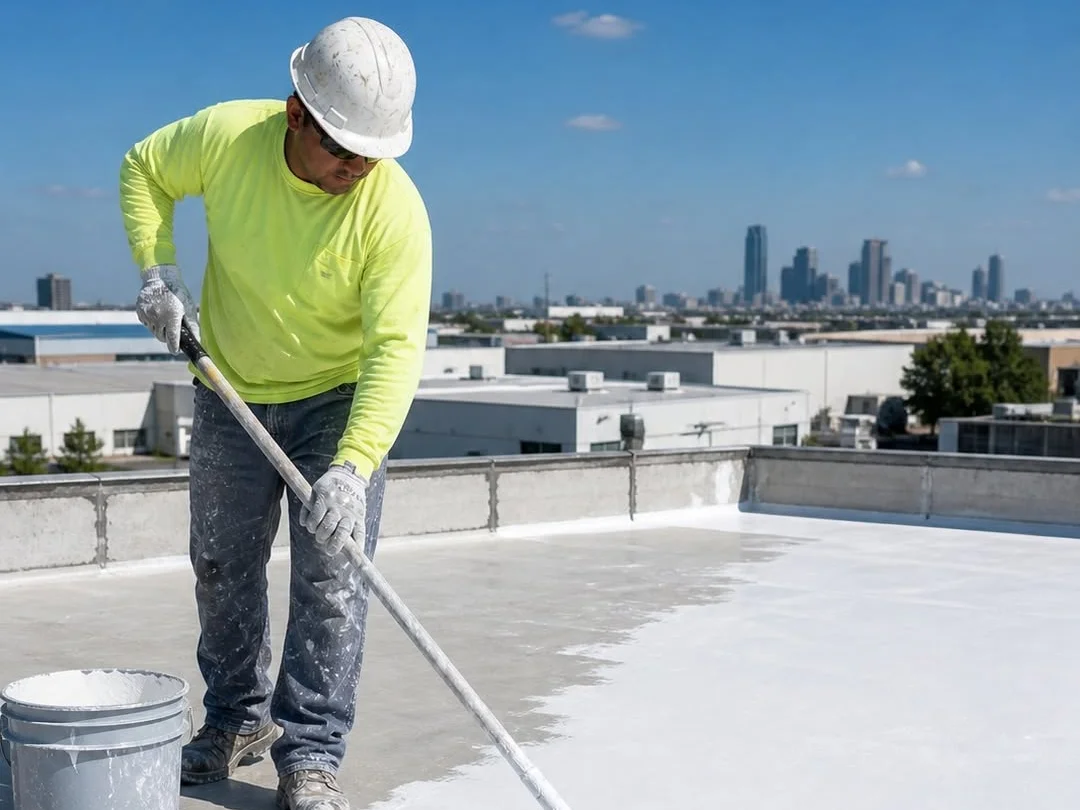
Radiative cooling paint is a white, water-based coating that keeps roofs, tanks and outdoor equipment cool in direct sun without using any power. It does two things at once: it reflects almost all of the sunlight that lands on it, and it radiates its own heat away as infrared light in the 8 to 13 μm band, which passes through the atmosphere and out to space.
That second part is what separates it from ordinary heat-reflective or “cool roof” paint, which only reflects sunlight. Because radiative cooling paint also sheds heat, a coated surface can stay close to or below the air temperature even at midday.
In our side-by-side tests, coated surfaces run 20 to 30 °C cooler than uncoated ones in summer sun, and the space underneath is 7 to 15 °C cooler.
What is radiative cooling paint made of?
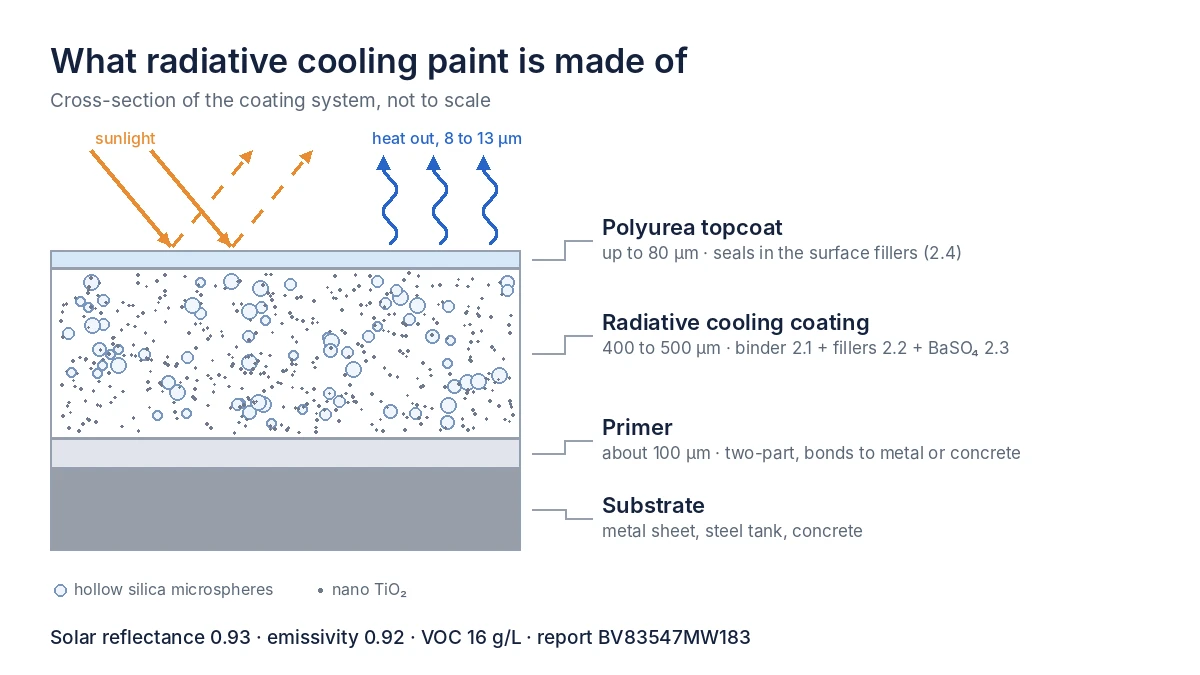
Our radiative cooling paint is a water-based coating with three groups of ingredients, applied as part of a three-layer system.
Binder: 40 to 50%
The binder is a weather-resistant water-based silicone-acrylic or acrylic emulsion. It forms the film that holds everything else together and bonds the coating to the surface.
Functional fillers: 30 to 40%
This is the part that does the cooling. It has two components:
- Modified nano titanium dioxide (TiO₂). Its very high refractive index makes it scatter sunlight strongly, so most of the visible and near-infrared light that enters the coating is sent back out.
- Hollow silica microspheres. Each sphere is a thin glass shell around air, and every shell boundary scatters more sunlight. The silica itself emits strongly between 8 and 13 μm, the band where heat can escape through the atmosphere.
Barium sulphate and additives: the rest
A small amount of barium sulphate tops up the reflectance. Dispersants and levelling agents, the usual coating additives, keep the fillers evenly spread and let the film flow out smoothly.
The coating system
The paint goes on as three layers:
- Primer, about 100 μm. A two-part primer that bonds the system to metal or concrete.
- Radiative cooling coating, 400 to 500 μm in two coats. This is the paint described above.
- Polyurea topcoat, up to 80 μm. Because the coating is packed with nano fillers, some of them sit at the surface. Left uncovered, they chalk off in sun and rain over time and the cooling fades with them. The topcoat, our HZ06 Polyaspartic Waterproof Topcoat, seals them in and keeps the surface clean.
How does radiative cooling paint work?
A surface in the sun gets hot when it takes in more energy than it gives off. Radiative cooling paint works on both sides of that balance.
It reflects sunlight
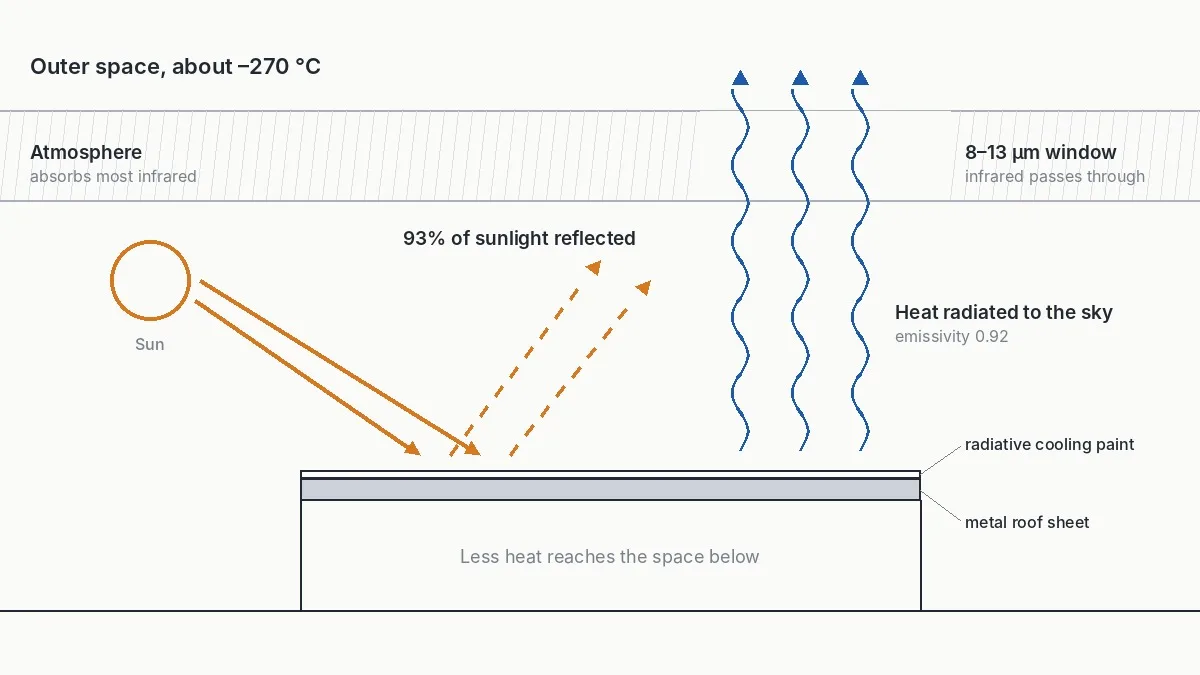
Sunlight arrives as ultraviolet, visible and near-infrared light, roughly 0.3 to 2.5 μm. Almost half of its energy is near-infrared, which you can’t see, so a surface can look bright white and still absorb a lot of heat. The titanium dioxide, the hollow microspheres and the barium sulphate scatter this light back out. In third-party testing our radiative cooling paint reflected 93% of sunlight.
It radiates heat through the atmospheric window
Every warm surface gives off infrared radiation. Water vapour and CO₂ in the air absorb most of it, but between 8 and 13 μm the atmosphere is close to transparent. Heat emitted in this band, known as the atmospheric window, goes straight out to space, which is at about -270 °C. Our coating has an emissivity of 0.92, mostly thanks to the silica.
It can cool below air temperature
When a surface reflects almost all the sunlight and radiates heat this efficiently, it can lose more energy than it gains, even at noon. Under a clear sky its temperature then settles at or below the air temperature. This effect is called passive daytime radiative cooling (PDRC), and a Stanford group first demonstrated it in direct sun in 2014 (Raman et al., Nature). The coating keeps radiating after sunset, so the surface also cools down faster in the evening.
The effect is strongest in hot, dry, sunny weather. High humidity partly closes the atmospheric window, so cooling below air temperature is weaker there, but the coating still reflects most of the sunlight and the surface stays far cooler than an uncoated one.
Performance and test data
Third-party test results
The figures below come from a third-party commissioned test of our radiative cooling paint by Guangzhou BV Technology Testing Co., Ltd. (report No. BV83547MW183, issued March 2026). We send the full report on request.
| Specification | What it tells you | Our result |
|---|---|---|
| Solar reflectance | Share of total sunlight reflected | 0.93 |
| Emissivity | How strongly the coating emits heat as infrared radiation | 0.92 |
| Artificial weathering | Resistance to UV and weathering | 1,000 h, no blistering, peeling or cracking |
| Neutral salt spray | Corrosion resistance in coastal and industrial air | 500 h, no damage |
| Adhesion (cross-cut) | How firmly the coating bonds to the substrate | Grade 0 (best) |
| Water contact angle | Hydrophobicity; rain helps wash off dust | 152° |
| Stain resistance | Loss of reflectance after soiling | 3% |
| Scrub resistance | Surface durability | 2,000 cycles, no damage |
| VOC content | Emissions during application | 16 g/L |
| Formaldehyde, benzene series, heavy metals | Health and environmental safety | Not detected |
Typical cooling results
We have tested the coating many times on metal sheet, concrete and equipment cabinets, each time side by side with an uncoated surface under the same sun. In summer the coated surfaces run 20 to 30 °C cooler than the uncoated ones, and the space inside or underneath is 7 to 15 °C cooler. The gains are largest on thin metal roofs and cabinets, where most of the heat would otherwise go straight through.
What makes our radiative cooling paint different
A high load of functional filler
Functional fillers make up 30 to 40% of the coating. The combination of nano titanium dioxide and hollow silica microspheres covers both jobs, reflecting sunlight and radiating heat, which is how the coating reaches 0.93 solar reflectance and 0.92 emissivity at the same time.
A weather-resistant, water-based binder
The silicone-acrylic binder holds up to sun and rain, and the paint is water-based. Its tested VOC content is 16 g/L, and formaldehyde, benzene-series compounds and heavy metals were below detection limits.
A polyurea topcoat that locks the performance in
The polyurea topcoat stops the surface fillers from chalking away, so the cooling lasts. With it, the system went through 1,000 hours of artificial weathering without blistering, peeling or cracking, and 500 hours of salt spray without damage. The surface is strongly water repellent (contact angle 152°), so rain carries dust off, and it lost only 3% of its reflectance in the stain test.
It goes on any shape
The coating is applied by spray or roller, so it covers tank shells, pipework, cabinets with many fittings and irregular roofs as easily as flat sheet. It bonds firmly to the substrate, with Grade 0 cross-cut adhesion, the best rating. For large, flat roofs where a pre-made membrane is quicker to lay, we also make radiative cooling film.
If you are looking at radiative cooling paint for a roof, tank or cabinet project, send us the substrate, the area and your location. We’ll reply with a system recommendation, the full test report and a quote, and we can send a sample for your own trial. Ahonesty radiative cooling paint is made by Shandong Huacheng High-Tech Material Technology Co., Ltd. in Qingzhou, Shandong.
WhatsApp: +853 6649 6268 | Email: shawn@ahonestymaterial.com