
What is radiative cooling film?
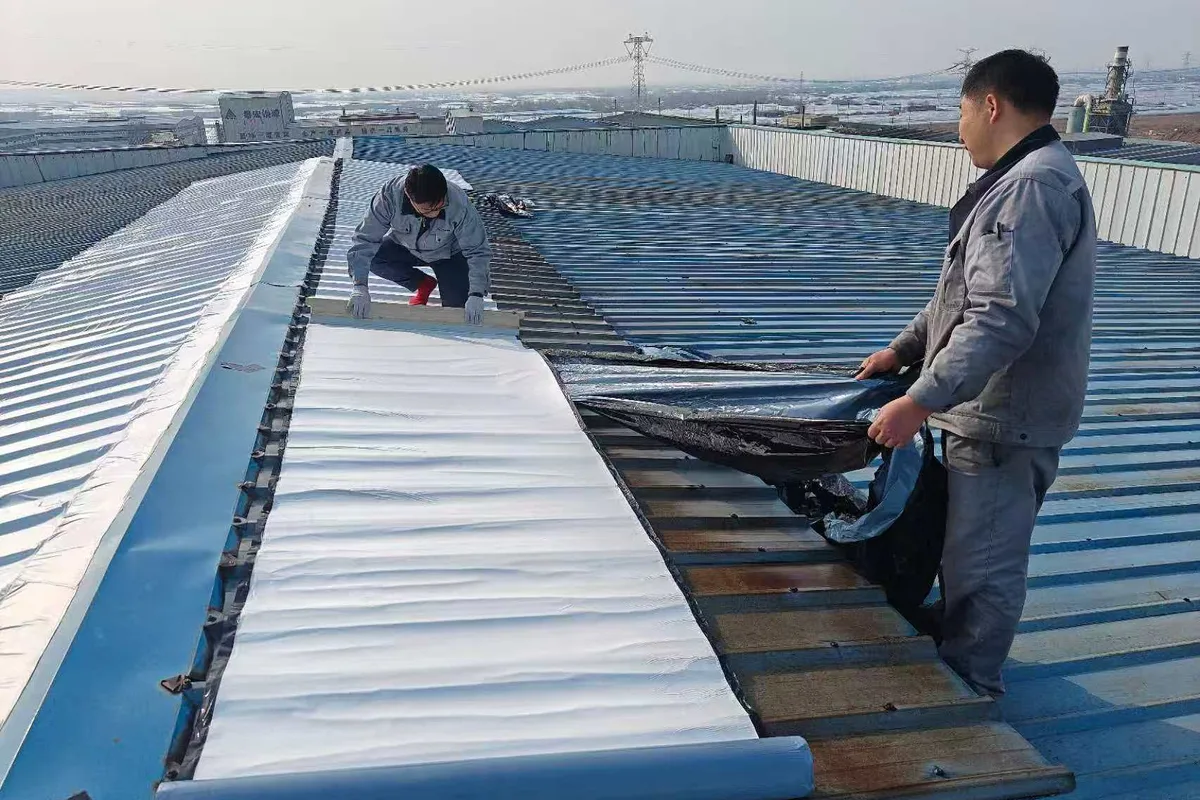
Radiative cooling film is a white, multi-layer polymer membrane that sticks onto roofs, walls and outdoor equipment and keeps them cool in direct sun without using any power. It does this in two ways at once: it reflects most of the sunlight that lands on it, and it radiates its own heat away as infrared light in the 8 to 13 μm band, which passes through the atmosphere and out to space.
That second part is what separates it from an ordinary reflective film or white paint, which only reflect sunlight. Because radiative cooling film also sheds heat, it can keep a surface close to or below the air temperature even at midday.
In practice, a film-covered metal roof in summer typically runs 15 to 30 °C cooler than bare sheet, and the space underneath is 6 to 15 °C cooler.
What is radiative cooling film made of?
Our radiative cooling film has three layers. From the top down:
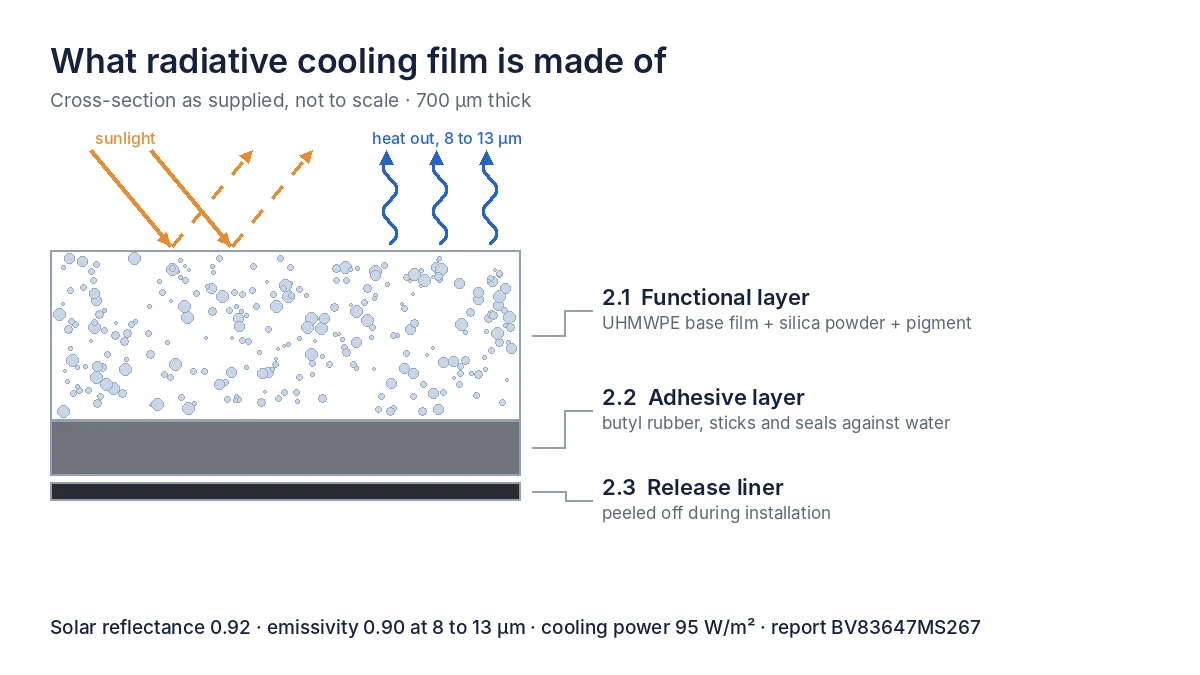
Functional layer
This is the layer that does the cooling. It has three components:
- Base film: ultra-high-molecular-weight polyethylene (UHMWPE). It carries the functional particles and gives the film its strength and weather resistance. Section 5 explains why we chose it.
- Modified silica (SiO₂) powder in nano and micron particle sizes. Silica is the main heat emitter. The silicon-oxygen bond vibrates at about the same wavelength as the 8 to 13 μm atmospheric window, so silica radiates very strongly in exactly that band.
- A small amount of high-refractive-index pigment. Together with the silica particles, it scatters incoming sunlight back out of the film before it can be absorbed.
Adhesive layer
Under the functional layer is a butyl rubber adhesive. It bonds the film directly to metal, concrete, glass and most plastics, and seals the surface against water, so on many roofs the film also works as a waterproofing membrane.
Release liner
A release liner protects the adhesive until installation and is peeled off as the film goes down.
Size
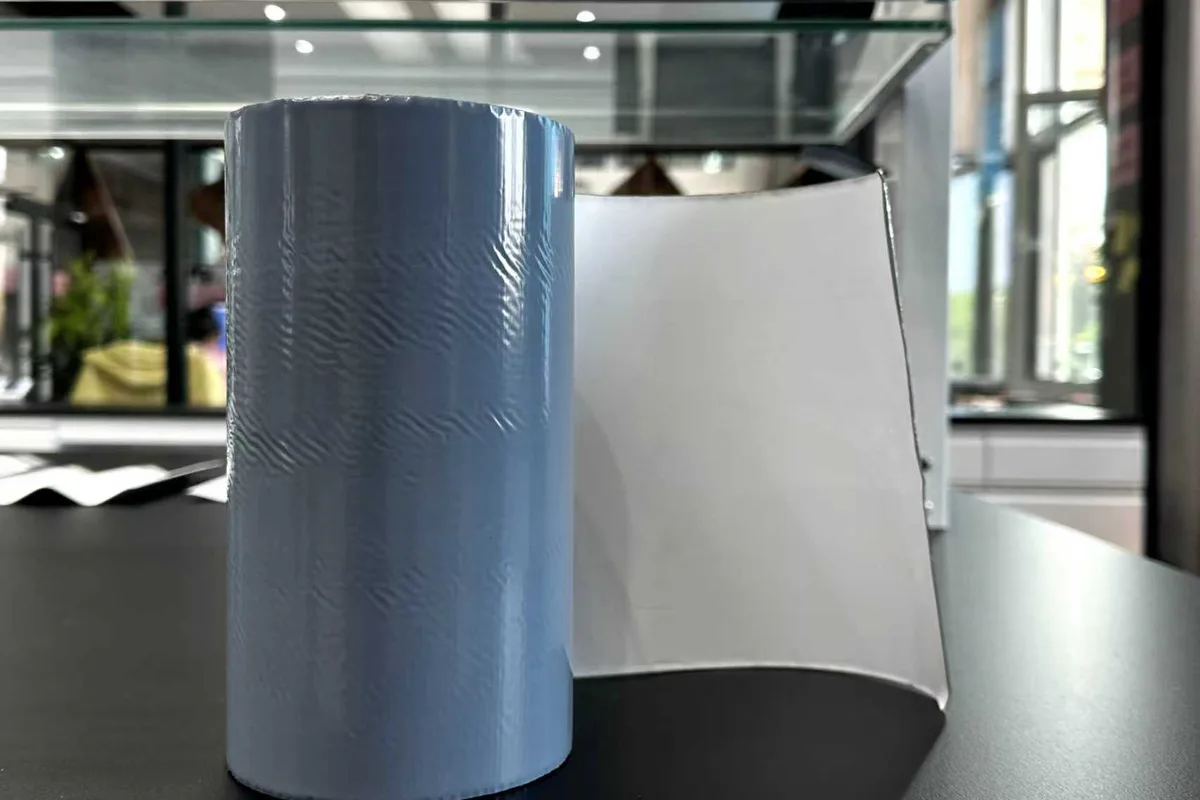
The film is 700 μm thick and is supplied in rolls 1 m wide and 10 m long. Other sizes are available on request.
How does radiative cooling film work?
A surface in the sun gets hot when it takes in more energy than it gives off. Radiative cooling film works on both sides of that balance.
It reflects sunlight
Sunlight arrives as ultraviolet, visible and near-infrared light, roughly 0.3 to 2.5 μm. Almost half of its energy is near-infrared, which you can’t see, so a surface can look bright white and still absorb a lot of heat. In third-party testing our radiative cooling film reflected 92% of total sunlight and 95% of near-infrared light, so very little solar energy gets into the roof.
It radiates heat out through the atmospheric window
Every warm surface gives off infrared radiation. Water vapour and CO₂ in the air absorb most of it, but between 8 and 13 μm the atmosphere is close to transparent. Heat emitted in this band, known as the atmospheric window, goes straight out to space, which is at about -270 °C.
The film’s emissivity in this band is 0.90. Its measured net cooling power is 95 W/m², which means that under the test conditions each square metre was sending about 95 watts more heat to the sky than it took in.
It can cool below air temperature
When a surface reflects almost all the sunlight and radiates heat this efficiently, it can lose more energy than it gains, even at noon. Under a clear sky its temperature then settles at or below the air temperature. This effect is called passive daytime radiative cooling (PDRC), and a Stanford group first demonstrated it in direct sun in 2014 (Raman et al., Nature). Radiative cooling paint works on the same principle. The film keeps radiating after sunset too, so the roof also cools down faster in the evening.
The effect is strongest in hot, dry, sunny weather. High humidity partly closes the atmospheric window, so cooling below air temperature is weaker there, but the film still reflects most of the sunlight and the roof stays far cooler than bare metal.
Performance and test data
Third-party test results
The figures below come from a third-party commissioned test of our radiative cooling film by Guangzhou BV Technology Testing Co., Ltd. (report No. BV83647MS267, issued March 2026). We send the full report on request.
| Test item | What it tells you | Result |
|---|---|---|
| Solar reflectance | Share of total sunlight reflected | 0.92 |
| Near-infrared reflectance | Reflection of the invisible half of solar energy | 0.95 |
| Emissivity (8 to 13 μm) | How strongly it radiates heat through the atmospheric window | 0.90 |
| Radiative cooling power | Net heat shed by radiation | 95 W/m² |
| Xenon-lamp ageing, 1,500 h | UV and weathering resistance | Reflectance change 2%, ΔE 3.2, no peeling |
| Salt spray, 1,500 h | Corrosion resistance in coastal and industrial air | ΔE 0.6, no peeling |
| Damp heat, 1,500 h | Stability in hot, humid conditions | ΔE 0.2, no delamination |
| Tensile strength (long./trans.) | Resistance to tearing during and after installation | 42 / 25 MPa |
| Elongation (long./trans.) | Ability to move with the roof | 48% / 65% |
| Peel strength | Adhesive bond to the substrate | 1.8 N/mm |
| Stain resistance | Loss of reflectance after soiling | 7% |
| Water contact angle | Hydrophobicity; rain helps wash off dust | 120° |
Typical cooling results
On a sunny summer day, a film-covered metal roof typically sits 15 to 30 °C below an uncovered one, and the space underneath runs 6 to 15 °C cooler. In air-conditioned buildings the cooling load typically drops by 30 to 60%. The bigger savings come on thin, uninsulated metal roofs, where most of the building’s heat gain comes through the roof.
Why our radiative cooling film is built on UHMWPE
The silica and pigment do the cooling, but the base film decides whether they keep doing it after several summers outdoors. We built ours on ultra-high-molecular-weight polyethylene for four reasons.
It keeps the cooling particles locked in
UHMWPE has extremely long molecular chains, which makes it much tougher than ordinary polyethylene. When the film is biaxially stretched, it grips the silica and pigment particles evenly and holds them in place. If a base polymer breaks down in the sun, the surface chalks, the particles wash off in the rain, and the cooling fades with them. After 1,500 hours of xenon-lamp ageing, the solar reflectance of our film changed by only 2%.
It lets the heat out
A base film that absorbs infrared light would trap the heat the silica is trying to radiate. Polyethylene is largely transparent between 8 and 13 μm, so the heat passes out through the film to the sky.
It needs no protective topcoat
Many cooling films need an extra protective layer, such as a polyurea topcoat, to survive outdoors. That adds material cost and another step on site, and the topcoat itself ages. Our film is UV resistant, waterproof and abrasion resistant on its own, and it also passed 1,500 hours each of salt spray and damp heat without peeling or delamination.
It is strong enough for the roof
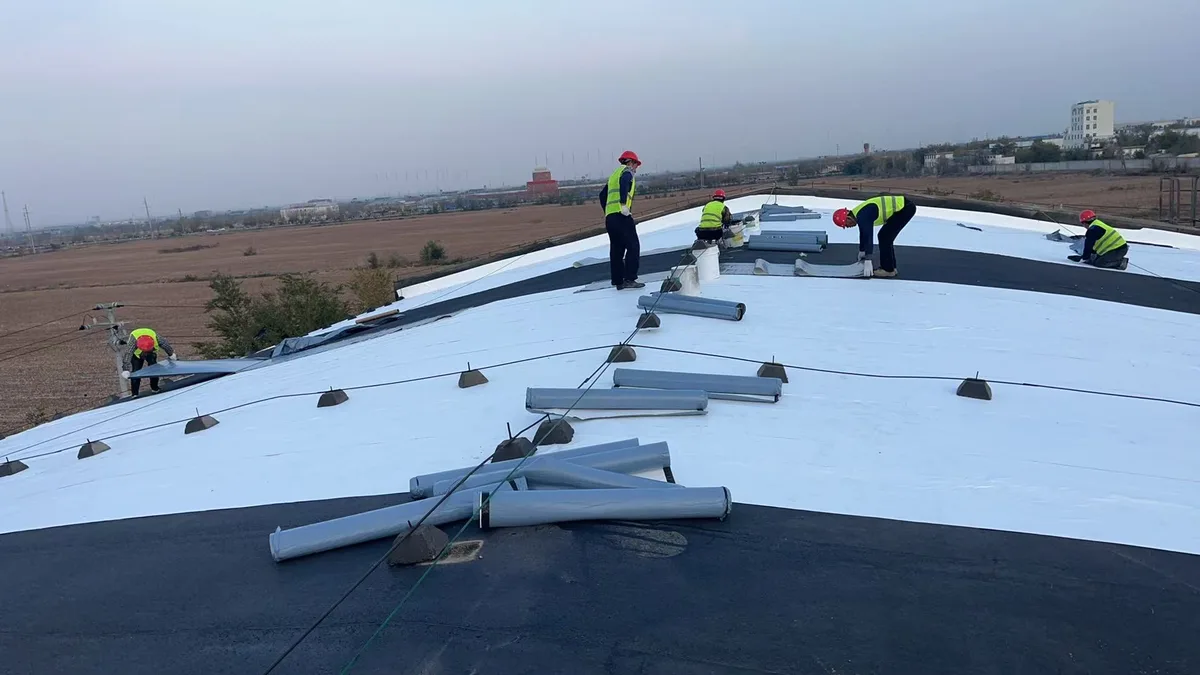
In testing the film reached a tensile strength of 42 MPa lengthwise and 25 MPa across, with 48% and 65% elongation, so it moves with the roof as it heats and cools without tearing. Its butyl adhesive holds with a peel strength of 1.8 N/mm, and the film goes on like a self-adhesive membrane with no spraying and no curing time.
If you are looking at radiative cooling film for a roof or equipment project, send us the substrate, the area and your location. We’ll reply with a recommendation, the full test report and a quote, and we can send a sample for your own trial. Ahonesty radiative cooling film is made by Shandong Huacheng High-Tech Material Technology Co., Ltd. in Qingzhou, Shandong.
WhatsApp: +853 6649 6268 | Email: shawn@ahonestymaterial.com