Industrial roofs, storage tanks and other large outdoor facilities need cooling that keeps working without power, and passive radiative cooling materials are now widely used for this. Products on the market follow different technology routes, and their service lives vary a lot. Some perform well at first, then degrade, turn white and fail within 1 to 3 years, which leaves the owner with high maintenance costs later on.
Below we explain how our radiative cooling film is built and how it cools. We then compare it side by side with the two most relevant competing routes: brand A (coating-type reflective film) and brand B (metal-backed particle film). The comparison covers stability, service life and overall cost for large industrial outdoor projects.
What our radiative cooling film is
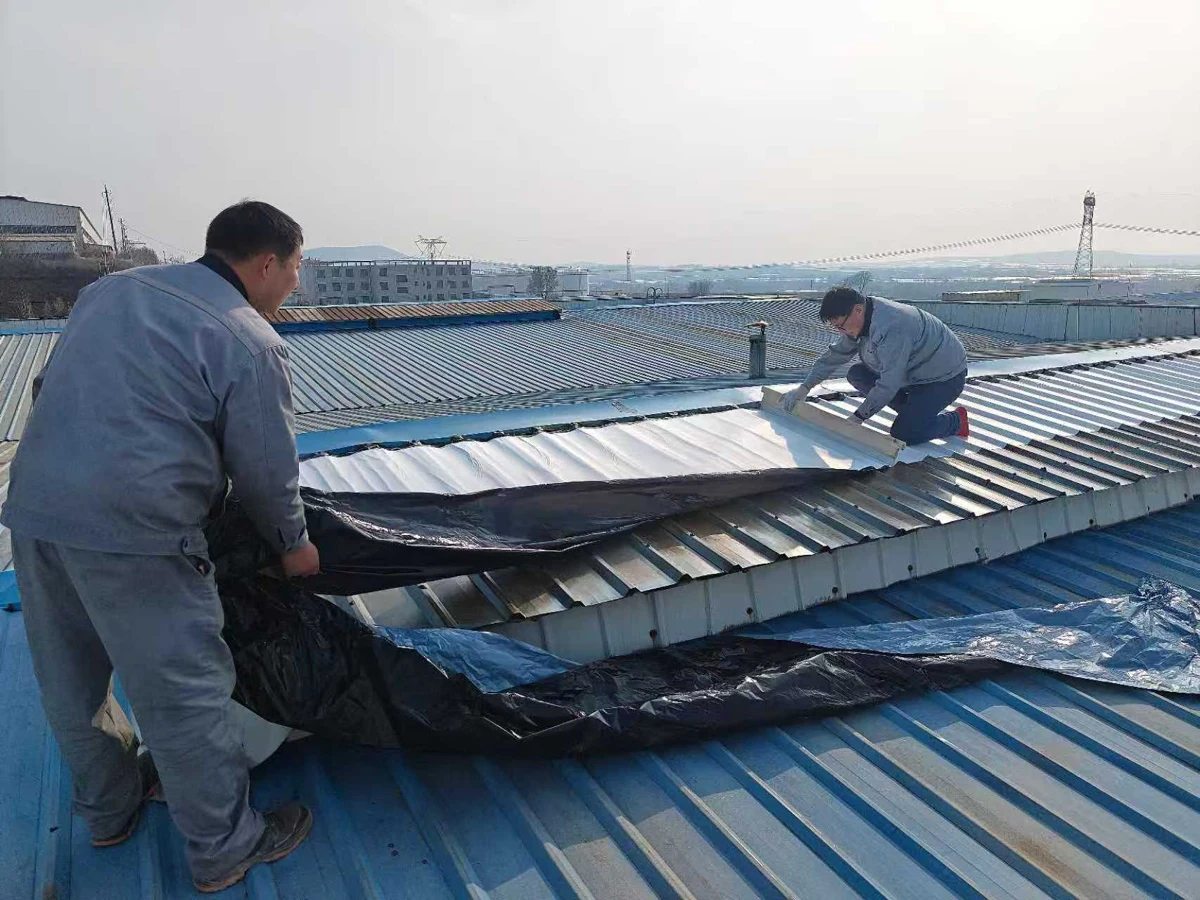
Our product is an opaque, industrial-grade radiative cooling film supplied in rolls. It is made for steel structure roofs, colour steel sheet factory roofs, warehouse roofs and large storage tanks, where big areas have to be covered.
What it is made of
The film is based on ultra-high-molecular-weight polyethylene (UHMWPE). Modified silica powder and a small amount of high-refractive-index pigment are held inside the film. Standard rolls are 700 μm thick and 1 m wide.
The powder is not simply blended into the plastic. UHMWPE has extremely long molecular chains, and these chains form a dense network. The cooling powder sits locked in the gaps between the chains, a structure we call powder locking. Because of this:
- the powder does not migrate, leach out or clump together;
- reflection and emission stay uniform across the whole roll;
- the film resists acid, alkali, salt spray and UV ageing much better than plain blended film.
How it cools
The film cools a surface in two ways at once. The silica and pigment particles reflect sunlight back out, so the surface takes in less solar heat. The silica also emits heat as infrared radiation in the 8 to 13 μm atmospheric window, where the air is largely transparent, so the heat passes out to the sky. Both work without electricity, by day and by night.
Our guide to what radiative cooling film is and how it works covers the physics in more detail.
The radiative cooling film market: three technology routes
Besides our UHMWPE film, the radiative cooling films sold for roofs mostly follow one of two routes.
Brand A: coating-type reflective film
An optical coating is applied on top of a base film. The coating does the reflecting, and it sits on the outside, directly exposed to UV, rain and temperature cycling.
Brand B: metal-backed particle film
Cooling powder is stirred into an ordinary polyethylene or polypropylene substrate. A multilayer structure with a highly reflective metal layer on the back is added to cut solar absorption further.
Side-by-side comparison
Competitor figures are taken from public industry test reports, manufacturer white papers and third-party ageing data. Where a figure comes only from the manufacturer, the table says so. Our figures are our published product specifications.
| Comparison | Our UHMWPE radiative cooling film | A: coating-type reflective film | B: metal-backed particle film |
|---|---|---|---|
| Solar reflectance | ≥ 95% | 98% (manufacturer claim, no third-party verification) | ≥89% (manufacturer claim, no third-party verification) |
| Emissivity, 8 to 13 μm | ≥ 0.90 | 98% (manufacturer claim, no third-party verification) | ≥93% (manufacturer claim, no third-party verification) |
| Ageing tests | 1,500 h xenon lamp, 1,500 h salt spray and 1,500 h damp heat, run separately | 1,500 h salt spray / humidity (no public data) | Conventional xenon ageing (no public data) |
| Performance change after ageing | Solar reflectance changed by 2% after 1,500 h xenon lamp | Not published | Not published |
| How it cools | High solar reflection plus heat emission through the atmospheric window | Optical coating on a base film; reflection at the surface | Particle spectral tuning plus a reflective metal back layer |
| Service life | Up to 20 years in laboratory evaluation; more than 10 years in real use | About 10 years (manufacturer estimate, no long-term verification) | Not published |
| Product form | Opaque industrial rolls for roofs and tanks | Roll film (coating on base film); also sold as liquid coating | Rolls, films, metal sheets and panels (12 product types) |
| Main point to note | Built for weathering; not marketed for abrasion or tensile duty | Surface coating can chalk, age or delaminate | Particle migration and whitening; no combined ageing standard |
Common ageing problems with the other two routes
Brand A: coating-type reflective film
Typical problems after 3 to 5 years outdoors:
- the surface coating ages, chalks and delaminates;
- performance drops gradually as the coating wears;
- no official ageing decay data is published, and nothing is validated by a third party.
The film performs well at first, but how long the coating lasts has not been shown by independent testing.
Brand B: metal-backed particle film
Typical problems after 3 to 5 years outdoors:
- powder inside the film migrates and leaches out, and large areas of the surface turn white and mottled;
- reflection and emission keep falling, and there is no combined ageing test standard;
- overall cooling performance drops significantly over time.
Why choose our film
Optical performance
The film reflects at least 95% of sunlight, so the roof takes in much less solar heat. Its emissivity in the 8 to 13 μm band is at least 0.90, so heat keeps leaving the surface for the sky. Its radiative cooling power reaches up to 100 W/m². Test reports are available on request.
Weathering stability you can check
Most competitors do not publish full ageing data or decay rates. We publish ours. The finished film passed three separate 1,500-hour ageing tests:
- Xenon lamp ageing: solar reflectance changed by only 2%, colour change ΔE 3.2, no peeling.
- Salt spray: colour change ΔE 0.6, no peeling.
- Damp heat: colour change ΔE 0.2, no delamination beyond the edge and no peeling beyond 2 mm.
The powder-locking structure is what keeps these numbers low. It prevents the powder migration, surface whitening and early performance loss seen in blended films.
Made for industrial sites
The film comes as opaque industrial rolls that suit steel structure roofs, colour steel sheet factory roofs, large storage tanks and warehouse roofs. Transparent window films and small premium sheets cannot do this job.
Long service life and lower lifecycle cost
Laboratory evaluation puts the film’s service life at up to 20 years, and in real use it lasts more than 10 years. Coating-type films typically need recoating every 3 to 5 years, and blended films lose performance quickly. With our film, one installation keeps saving energy for years, with far less rework, labour and replacement material.
The film is positioned as a weather-resistant industrial cooling film. Our development work has focused on long outdoor service, resistance to ageing and corrosion, and stable performance, rather than on abrasion or tensile duty.
Frequently asked questions
How does radiative cooling film compare with cool-roof paint?
Both reduce solar heat gain and both emit in the 8-13 μm window. Film is factory-made, so its thickness and optical properties are set before it reaches the roof, and it can be installed without curing time. Paint is applied on site and follows irregular shapes and existing equipment. Large flat metal roofs usually favour film; cabinets, tanks, silos and concrete favour coating. We make both, so the recommendation is based on the substrate rather than on what we prefer to sell.
Does the film lose its cooling performance as it ages?
That is the main failure mode of the competing routes described above: a coating or metal layer degrades and the film turns white or peels within a few years. Our film is tested for 1,500 hours of xenon-lamp aging (ΔE 3.2, no peeling), 1,500 hours of neutral salt spray (ΔE 0.6) and 1,500 hours of damp heat (ΔE 0.2, no delamination).
Can the film be used on a roof that already has a waterproof membrane?
The film is self-adhesive and is laid on a prepared, sound and dry surface. Existing leaks, loose fasteners and unstable coatings should be repaired first. Whether it can go directly over a specific membrane depends on the membrane’s condition and compatibility, so we ask for the roof build-up before recommending it.
What thickness and width are supplied?
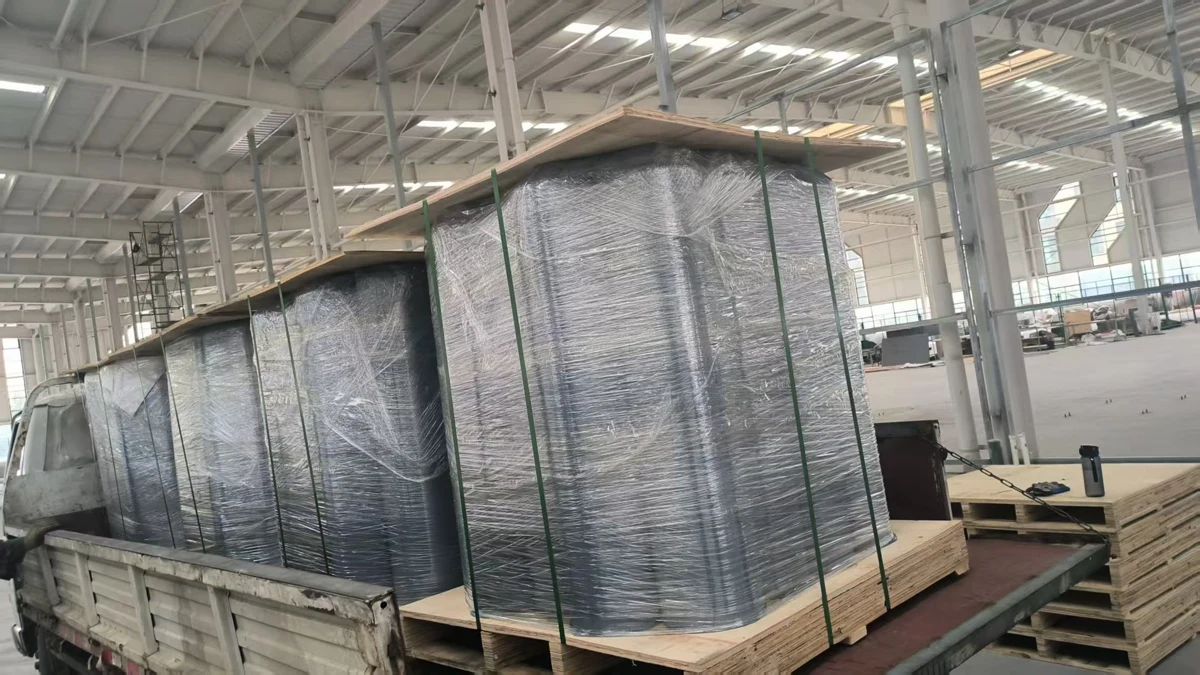
Standard rolls are 700 μm thick and 1 m wide, in 10 m lengths, with other dimensions available on request. The film carries a pressure-sensitive adhesive and is installed with a 3-5 cm overlap.
See the film in the field
Two projects show how the film performs outside a test report. In the Liaoning cold storage case study, the film was laid on an existing metal roof to cut heat gain before it reached the insulation. In the telecom cabinet study, film covered the flat top while coating covered the shaped side walls. The radiative cooling materials overview links both formats and their test data.
Request samples and the test report
Compared with the coating-type and metal-backed particle routes, our UHMWPE film avoids coating chalking and delamination as well as powder migration and whitening. It combines high cooling performance, published weathering data, a roll format for large installations and a long service life.
Send us your substrate, roof area and location. We will reply with a recommendation and a quote, and we can send samples with the full test report so you can try the film on your own site. The radiative cooling film product page has the full specifications.
Ahonesty radiative cooling film is made by Shandong Huacheng High-Tech Material Technology Co., Ltd. in Qingzhou, Shandong. WhatsApp: +853 6649 6268 | Email: shawn@ahonestymaterial.com