
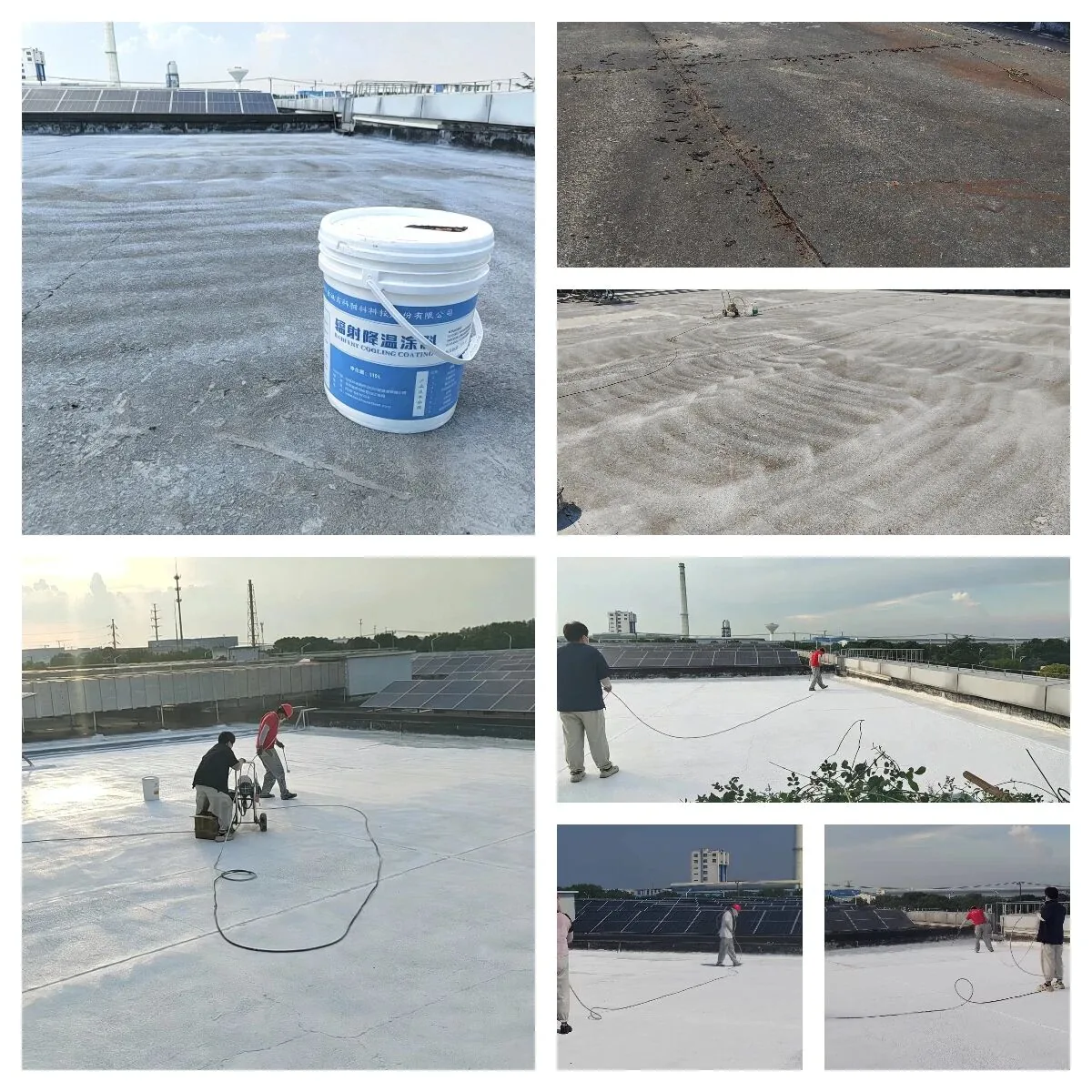
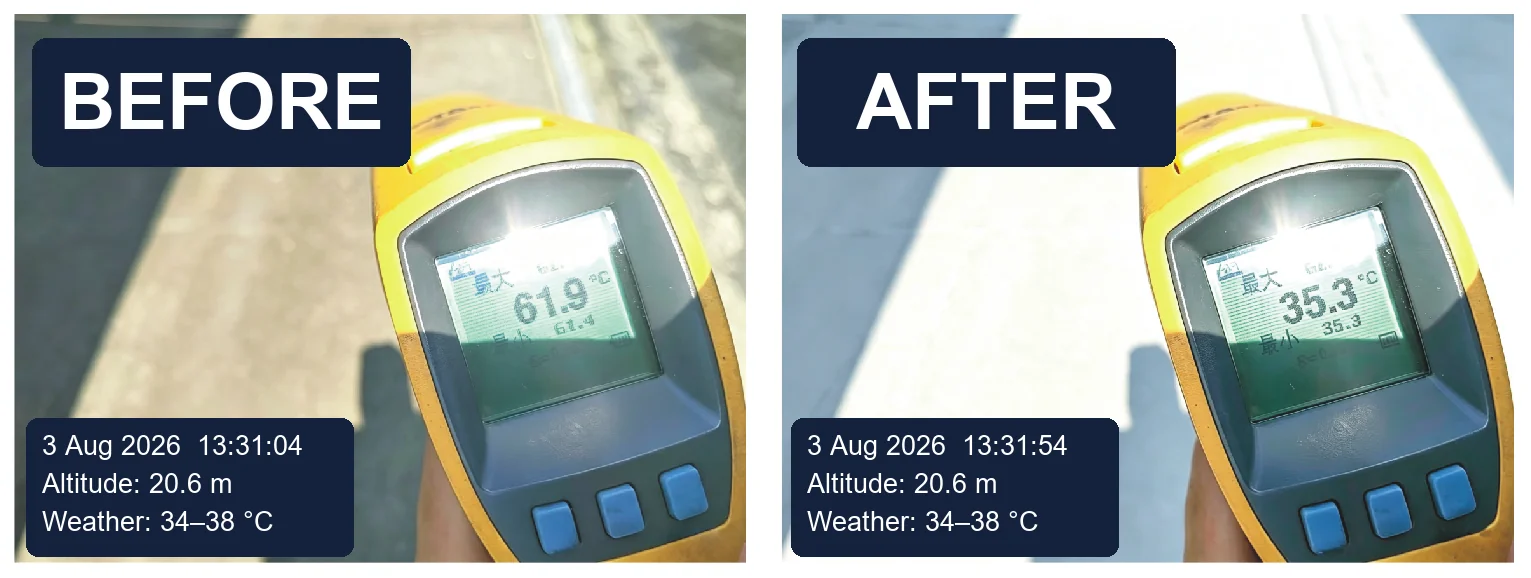
On a hot day, a factory roof behaves like a giant solar collector. Heat flows steadily into the building, the air conditioning struggles to keep up, the shop floor gets stuffy and the electricity bill climbs. A company in Wuzhong District, Suzhou, Jiangsu, recently had its factory roof sprayed with our radiative cooling paint. On a 34 to 38 °C day, the roof surface dropped from 61.9 °C before coating to 35.3 °C after.
Why factory roofs need radiative cooling
Factory roofs are mostly metal or concrete, materials that absorb sunlight readily and conduct heat quickly. Conventional insulation can only slow heat down; it cannot remove heat that has already built up. In summer the roof keeps absorbing heat and the heat load keeps pushing inward. Even with the air conditioning running hard, indoor temperatures fall slowly and power use stays high.
Radiative cooling paint works differently. It combines high solar reflectance with efficient infrared emission: it sends sunlight back and radiates heat away to space through the 8 to 13 μm atmospheric window. That cuts heat gain and lowers the building’s heat load. Our guide to radiative cooling paint explains how it works.
The project
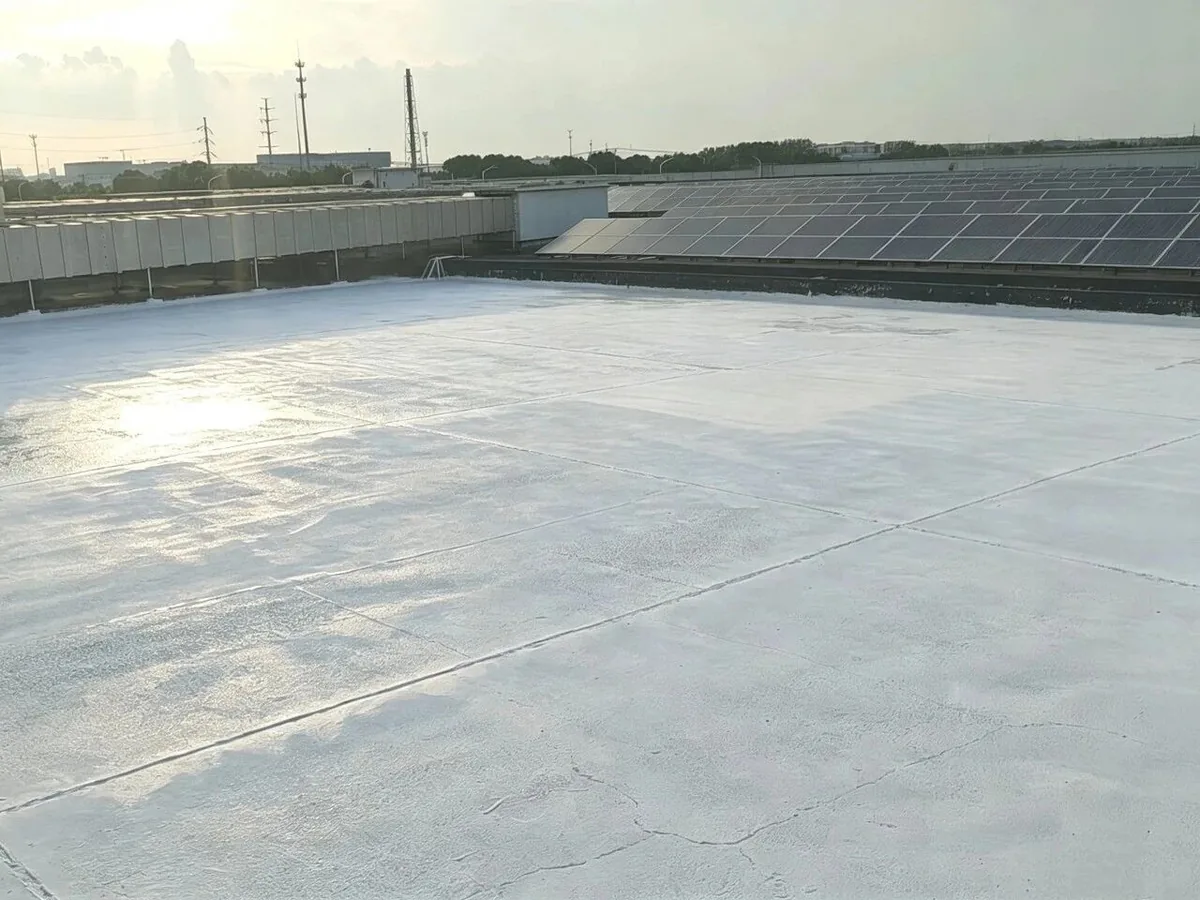
The job was on the company’s factory roof in Wuzhong District, Suzhou. The roof was of moderate size, with a concrete substrate. The paint system was applied by spraying in five steps:
- Surface preparation
- Radiative cooling primer
- First coat of radiative cooling paint
- Second coat of radiative cooling paint
- Radiative cooling clear topcoat
Application details
The crew followed the technical plan closely. The key points for each step:
| Step | Key points | Thickness / requirement |
|---|---|---|
| Surface preparation | Remove cracked or flaking layers and loose dust; grind and polish rusted spots; fill cracks with anti-crack mortar | Solid, clean substrate |
| Primer | Mix parts A and B at 18:2 and stir for at least 5 minutes; add no more than 2 kg of water per pail | About 100 μm; use within 2 hours of mixing |
| First coat | Spray; stir well after opening and thin with water if needed (no more than 10% by weight) | About 200 to 250 μm |
| Second coat | Apply only after the first coat is fully dry (at least 6 hours) | 400 to 500 μm for both coats; total no more than 600 μm |
| Clear topcoat | Apply at least 24 hours after the second coat; mix A and B at 2:3; never thin with water or solvent | No more than 80 μm; use within 1 hour of mixing |
Results
Infrared thermometer readings were taken on the roof on 3 August 2026 at about 13:30, with outdoor air at 34 to 38 °C, on an uncoated area and on the coated roof:
| Reading | Roof surface temperature |
|---|---|
| Before coating | 61.9 °C |
| After coating | 35.3 °C |
| Difference | 26.6 °C |
What a cooler roof means for the building:
- A cooler roof surface, so less heat conducts into the building.
- Less heat reaching the work areas under the roof, which matters most on the top floor.
- A lower cooling load for the air conditioning, since less heat comes in through the roof. Indoor temperatures and power use were not logged on this project, so we do not quote a saving.
- A protected roof surface: the clear topcoat seals the cooling layer and helps rain wash dust off.
Key data for our paint (more details on the radiative cooling coating product page):
| Property | Result |
|---|---|
| Solar reflectance | ≥ 0.90 |
| Emissivity (8 to 13 μm) | ≥ 0.90 |
| Adhesion (cross-cut) | Grade 0 |
| Water contact angle | 152° |
| VOC content | 16 g/L |
Frequently asked questions
How much cooler was the roof after coating?
On 3 August 2026 at about 13:30, with outdoor air at 34 to 38 °C, the roof read 61.9 °C before coating and 35.3 °C after, a difference of 26.6 °C.
How thick is the coating system?
About 100 μm of primer, two coats of radiative cooling paint totalling 400 to 500 μm (no more than 600 μm), and a clear topcoat of no more than 80 μm.
How long does application take between coats?
The second coat goes on at least 6 hours after the first is fully dry, and the clear topcoat at least 24 hours after the second coat.
Cooler factories without new equipment
The Wuzhong factory roof is one more example of radiative cooling at work on industrial buildings. Starting from cutting heat gain, with no new equipment and no rewiring, it helps factories become more energy-efficient and more comfortable to work in.
If you have a factory or warehouse roof that overheats in summer, send us the roof area, roof type (metal or concrete) and location. We will reply with a recommendation and a quote, and we can send samples so you can coat a test area first.
Ahonesty radiative cooling paint and film are made by Shandong Huacheng High-Tech Material Technology Co., Ltd. in Qingzhou, Shandong. WhatsApp: +853 6649 6268 | Email: shawn@ahonestymaterial.com