
Hazardous chemical storage tanks stand outdoors all year, and summer heat is a variable that safety managers cannot ignore. Some chemicals are sensitive to temperature: as the contents warm up, they evaporate faster, tank pressure rises, and the risk of leaks and overpressure goes up. Heat also ages the tank’s coating faster and weakens its corrosion protection. Radiative cooling paint offers a way to keep tank walls cooler without water or power.
The heat problem in chemical storage tanks
How heat builds up
Most chemical storage tanks are steel, which absorbs sunlight readily and conducts heat quickly. In direct summer sun, the shell can get much hotter than the surrounding air, and that heat flows steadily into the stored liquid. As the contents warm, evaporation increases, pressure builds and safety valves lift more often.
The limits of water spray cooling
The usual answer is a water spray system. Spraying works to a degree, but it uses a lot of water, and the constant flow over the shell speeds up the breakdown of the anti-corrosion coating. In dry regions, or in chemical parks with strict environmental rules, water use for spraying faces extra limits.
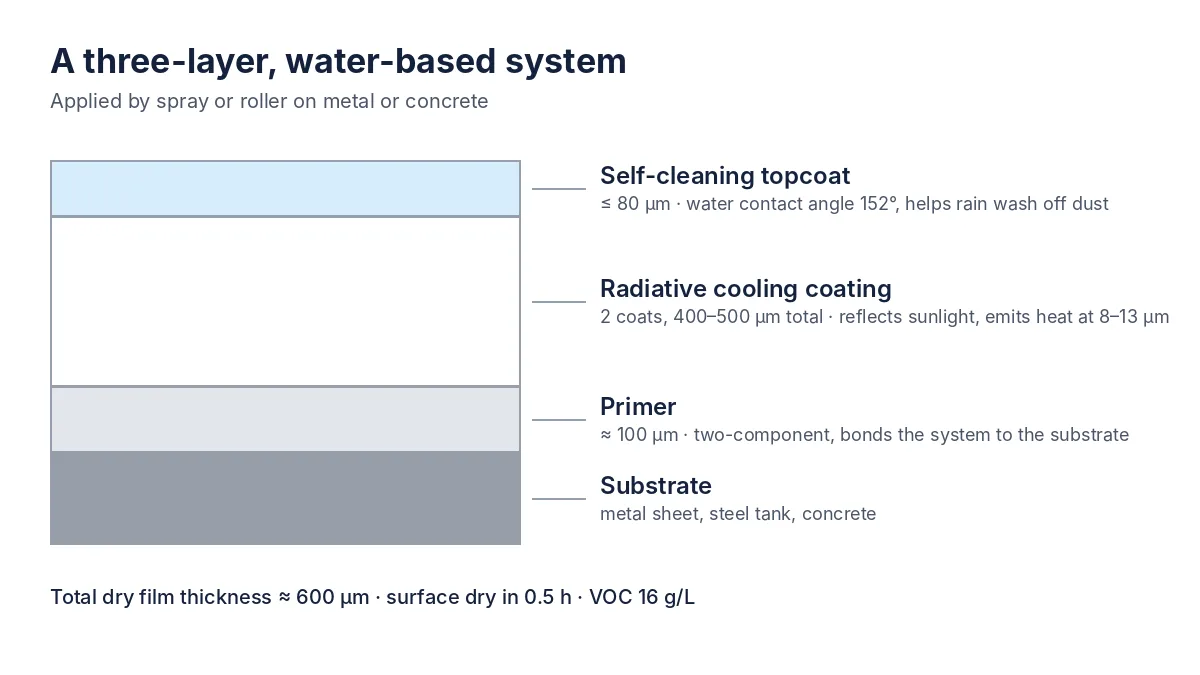
A different approach: radiative cooling paint
Radiative cooling paint takes another route. It uses no water, cools passively through physics, and protects against corrosion at the same time.
How it works
- High solar reflectance: the paint reflects most of the ultraviolet, visible and near-infrared sunlight, so the tank shell absorbs much less heat.
- Efficient infrared emission: it radiates the heat stored in the shell as infrared radiation through the 8 to 13 μm atmospheric window, out to space.
Working together, these let the coated surface stay below the ambient air temperature. The process uses no electricity, no water and has no moving parts. Our guide to radiative cooling paint explains the physics in more detail.
Why it suits chemical storage tanks
| Feature | Benefit for tank operators |
|---|---|
| Applied in service | The paint can be sprayed while the tank stays in normal operation, so production schedules are not disrupted |
| Corrosion protection | The coating itself resists corrosion and adds an extra layer of protection to the tank |
| Weather resistance | Built for long-term outdoor exposure |
| No water use | No spray system needed, which suits water-scarce sites and parks with strict environmental rules |
Key data for our paint (more details on the radiative cooling coating product page):
| Property | Result |
|---|---|
| Solar reflectance | ≥ 0.90 |
| Emissivity (8 to 13 μm) | ≥ 0.90 |
| Neutral salt spray | 500 h, no damage |
| Artificial weathering | 1,000 h, no blistering, peeling or cracking |
| Adhesion (cross-cut) | Grade 0 |
| VOC content | 16 g/L |
A supplement to existing safety systems
Radiative cooling paint is a supplementary cooling measure. It does not replace a tank’s existing spray system, ventilation, nitrogen blanketing, safety valves or other safety equipment. For tanks with strict temperature control requirements, active refrigeration or spray systems must remain the main means of temperature control.
What the paint adds is a passive layer that works around the clock: it lowers the heat load on the tank during the hottest hours, which helps reduce evaporation and pressure build-up and gives the existing systems less to do.
Other tanks that benefit
- Edible oil and grain storage tanks
- Fuel and solvent tanks at depots and plants
- Feed silos and other metal storage vessels
- Pipe racks and outdoor process equipment
Frequently asked questions
Can the paint be applied while the tank is in use?
Yes. It can be sprayed while the tank stays in normal operation, so production schedules are not disrupted.
Does it replace the tank’s spray or safety systems?
No. It does not replace spray systems, ventilation, nitrogen blanketing or safety valves. For tanks with strict temperature control, active refrigeration or spraying remains the main method.
Does the paint protect against corrosion?
Yes. The coating resists corrosion and passed 500 hours of neutral salt spray with no damage.
One more layer of protection for summer
Radiative cooling paint gives tank operators a way to cool tanks that uses no electricity and no water, and that also protects against corrosion. Used alongside existing safety systems, it adds another layer of protection for summer storage.
If you manage chemical or fuel storage tanks, send us the number of tanks, their diameter and height, the stored medium and the location. We will reply with a recommendation and a quote, and we can send samples for a test patch first.
Ahonesty radiative cooling paint and film are made by Shandong Huacheng High-Tech Material Technology Co., Ltd. in Qingzhou, Shandong. WhatsApp: +853 6649 6268 | Email: shawn@ahonestymaterial.com