A flat roof or a pool shell is usually recoated because the old topcoat has failed. The usual signs are chalking and fading in the sun, peeling where water has stood, or hairline cracks that let water reach the slab. Whichever coating goes on next has to be judged on how long it lasts outdoors and in water, how easy it is to apply well, and what it costs once labour and the next repaint are counted.
Below we compare our HZ06 polyaspartic topcoat with the topcoats contractors usually weigh it against, and say where it is the right choice and where a cheaper coating will do.
What HZ06 is
HZ06 is a two-component, solvent-free polyaspartic polyurea topcoat for concrete, cement screed, ceramic tile, marble and metal. It is rolled or squeegeed onto a primed surface and cures into a hard, flexible, seamless film that keeps water out. It is used on swimming pools, water tanks, flat roofs, balconies and bathrooms.
What it is made of
- Component A is polyaspartic ester resin, ground and dispersed with nano functional materials, ultrafine pigments and fillers, and additives. It carries the colour.
- Component B is an aliphatic polyisocyanate hardener based on HDI.
- The two are mixed 2:1 by weight. A set is 8 kg of A and 4 kg of B.
- Solids content is 95% or more, and the topcoat contains no solvent.
- It goes over a waterborne epoxy penetrating primer: HD400 on concrete and cement, HD300 on tile and marble.
How it works
When A and B are mixed, the amine groups in the resin react with the isocyanate groups in the hardener and form urea links. The film builds into a dense, crosslinked network that water cannot pass through. The polyaspartic ester reacts slowly enough to give about 20 minutes of working time, so the coating can be rolled by hand instead of sprayed. Because the hardener is aliphatic, the cured film does not yellow in sunlight the way aromatic coatings do.
Our article What Is Polyaspartic Polyurea Topcoat and How Does It Work? covers the chemistry in more detail.
How it compares with other topcoats
Contractors waterproofing roofs and pools usually choose between five kinds of topcoat, and each suits some jobs. They differ most in how they handle sun, standing water and the way they are applied.
| Point | Acrylic | Polyurethane | Epoxy | Spray polyurea | HZ06 polyaspartic |
|---|---|---|---|---|---|
| Colour stability in sun | Fades and chalks over time | Aliphatic: good. Aromatic: yellows | Yellows and chalks | Most types yellow unless topcoated | Good (aliphatic HDI hardener) |
| Standing water | Weak for long immersion | Depends on product and film build | Good | Good | No blistering after 168 h in water |
| Application | Brush or roller | Brush, roller or spray | Roller or squeegee | Heated plural-component spray rig | Roller or squeegee, 20 min working time |
| Solvent | Usually waterborne | Often solvent-borne | Solvent-free or solvent-borne | Solvent-free | Solvent-free, ≥ 95% solids |
| Over old tile | Needs a bonding primer | Needs a suitable primer | Good with primer | Needs specialist prep | Yes, with HD300 primer |
| Best use | Dry interiors, low budget | General protective coatings | Primer, covered floors | Large membranes with a spray crew | Exposed roofs, pools, tanks, tile renovation |
Polyaspartic vs acrylic
Acrylic coatings are cheap and easy to apply, and they are fine indoors or where the surface stays dry. Outdoors they chalk and lose gloss over time, and a thin acrylic film does not hold up well under standing water. On a pool or a roof that ponds, they usually need recoating within a few years.
Polyaspartic vs polyurethane
Polyurethane topcoats vary. Aromatic polyurethanes are tough but yellow in the sun. Aliphatic polyurethanes keep their colour well, but most are applied as thinner films, and many contain solvent. They are a sound choice on many surfaces. For a pool or a roof where water stands for long periods, the film build and water resistance of the chosen product matter more than the name on the can.
Polyaspartic vs epoxy
Epoxy bonds very well to concrete and resists water and chemicals, which is why our primers are epoxy. As a topcoat outdoors, epoxy yellows and chalks in direct sun. It works well under cover or as a base coat, less well as the exposed finish.
Polyaspartic vs spray polyurea
Conventional spray polyurea is fast and builds a thick, tough membrane in one pass. It reacts in seconds, so it needs a heated plural-component spray rig and a trained crew, and most spray polyurea is aromatic, so it yellows and chalks in the sun unless it is topcoated. It suits large projects where the equipment is already on site.
Where polyaspartic fits
A polyaspartic topcoat sits between these. It gives the colour stability of an aliphatic coating and the watertight, tough film of a polyurea, and it goes on with ordinary rollers. That combination is why it is used on exposed roofs, pools and tanks.
Why choose our polyaspartic topcoat
It holds its colour in the sun
The aliphatic HDI hardener gives HZ06 good resistance to yellowing. Pool surrounds, roofs and balconies stay the colour they were painted, and the film does not chalk the way an epoxy or aromatic topcoat does. That matters most on coloured pools and roofs, where fading is the first thing an owner notices.
It keeps water out, including standing water
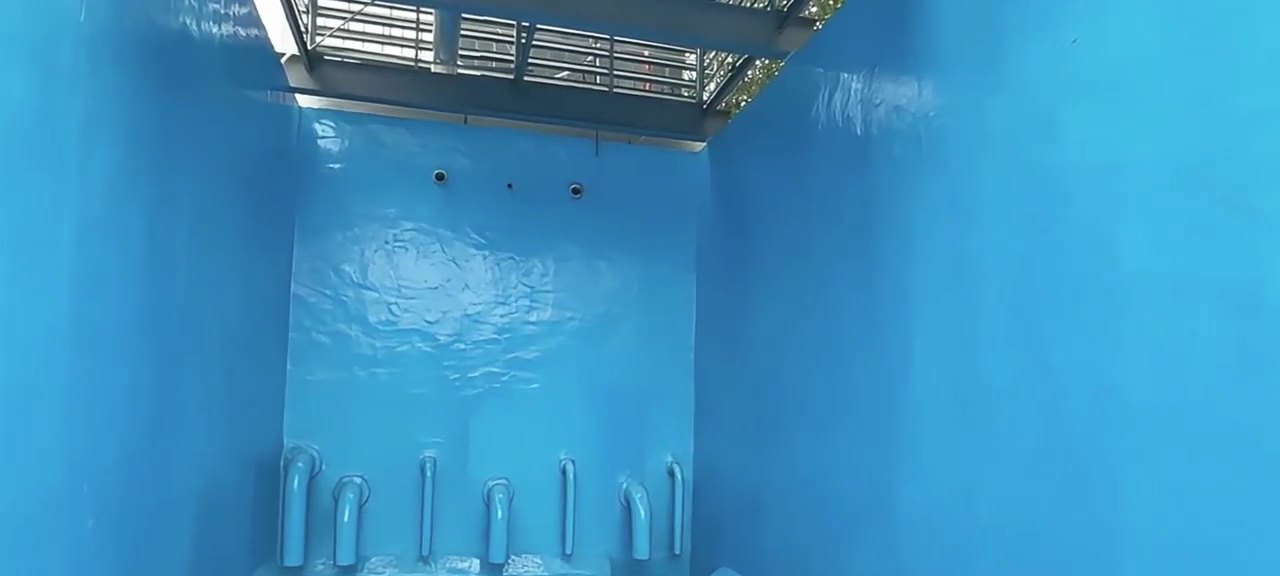
The cured film showed no blistering or peeling after 168 hours immersed in water, and no change after 48 hours in alkali, which matters on fresh concrete. Adhesion is rated grade 0 to 1. Because the film is rolled on, there are no laps or seams for water to find, and it follows corners, steps, upstands and drain outlets.
It is tough enough to walk on
The fully cured film reaches Shore D70 hardness, passes a 50 kg·cm impact test and bends over a 2 mm mandrel without cracking. It stands up to foot traffic on roofs and balconies and to cleaning in pools, and it can follow small movements in the slab.
One crew can apply it with rollers
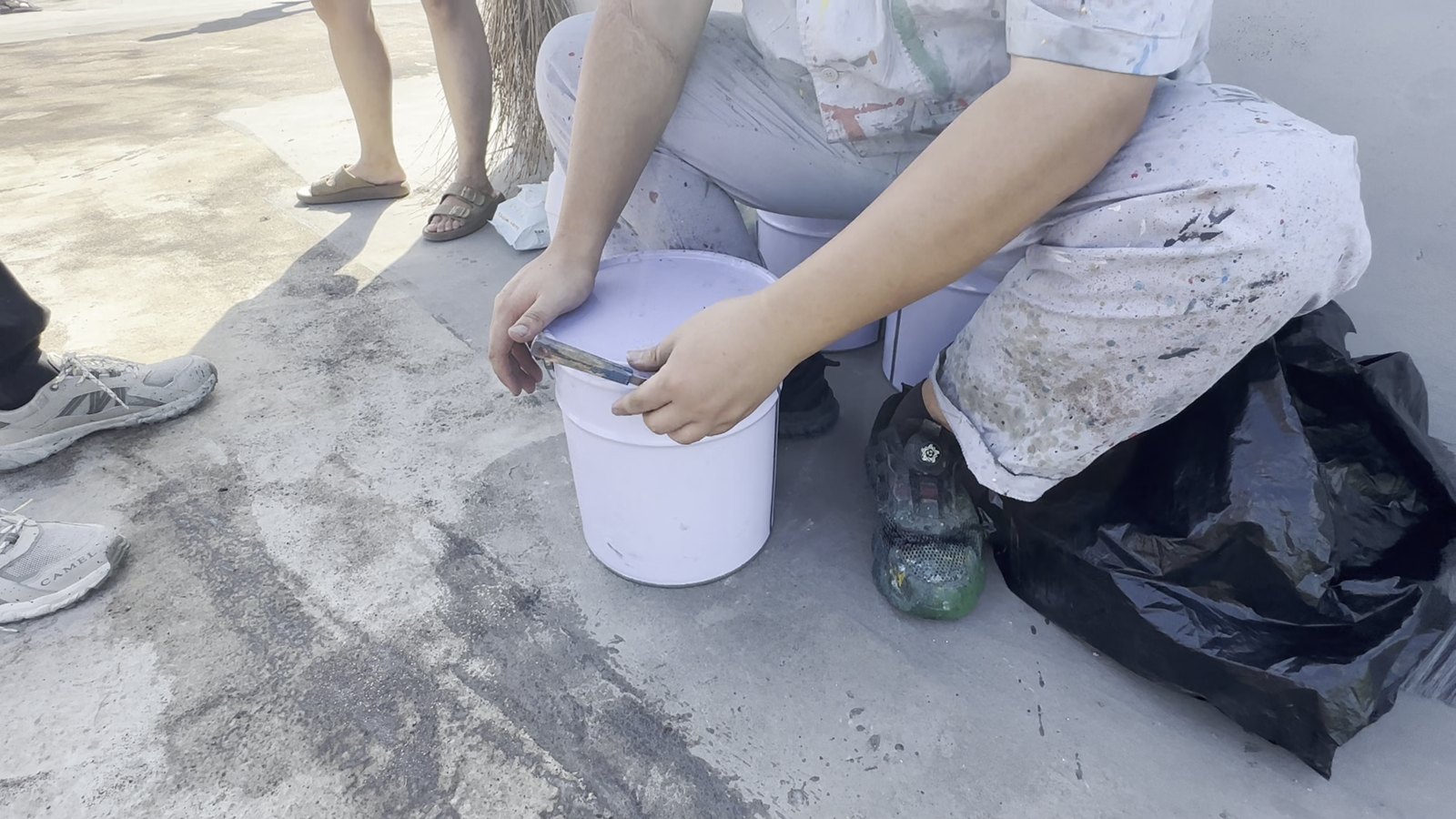
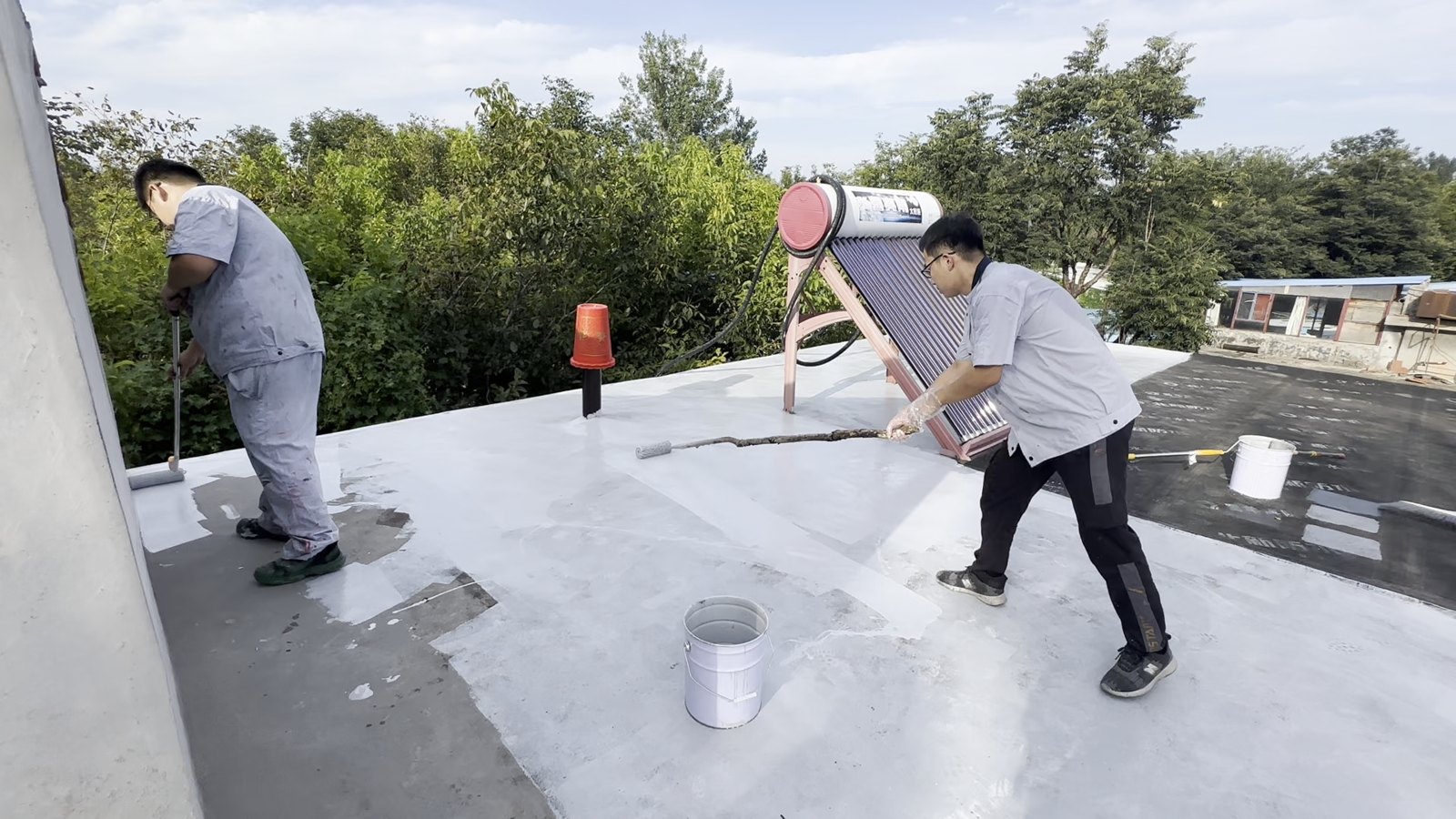
No spray rig, generator or heated hoses are needed. A crew mixes a set with an electric mixer for 10 to 30 seconds and has about 20 minutes to roll it out. Two roller coats use about 0.5 kg/m², or one squeegee coat about 0.35 kg/m². The primer needs 2 to 4 hours before the topcoat, and the first topcoat needs 2 to 4 hours before the second. That makes small and medium jobs practical for any waterproofing contractor.
It renovates tile and marble without demolition
With HD300 primer, HZ06 bonds to existing ceramic tile, marble and paving tiles. An old tiled pool, balcony or bathroom floor with failed grout can be sealed and recoloured in place, without breaking out the tiles. That saves the cost, noise and waste of demolition.
Solvent-free, with independent test data
HZ06 has 95% or more solids and no solvent. Indoors there is a slight odour that clears in 3 to 5 days with ventilation. In an independent lab test in January 2026 to GB/T 22374-2018, HZ06 met the Type W requirements for container state, film appearance, drying time and initial flow. It was dry to the touch in 3 hours and hard dry in 24 hours, with an initial flow of 188 mm against a minimum of 140 mm. We can send the report and the technical data sheet on request.
An anti-slip version for wet floors
For pool decks, steps and bathroom floors, the anti-slip system pairs the anti-slip version of HZ06 with our HQ06 anti-slip clear coat. Both are rolled in two coats over HD400 primer. The clear coat uses about 0.3 kg/m² and needs 3 to 5 days of curing before traffic or filling with water.
Supplied direct from our factory
Ahonesty coatings are made in our own plant, with 27 years in coatings R&D and manufacturing, a 90-acre site and 130,000 tonnes of annual capacity. Our quality systems are certified to ISO 9001, ISO 14001 and ISO 45001, and verified by SGS. We supply contractors and distributors directly, with a minimum order of 500 kg, and we can supply the primers, topcoat and anti-slip clear coat as one system.
When another coating makes more sense
HZ06 is not the right answer for every surface:
- For dry interior walls or floors where a low price matters most, an acrylic coating is usually enough.
- If the substrate cannot be dried before coating, for example a slab with rising damp or water pressure from behind, any highly watertight topcoat can blister. Fix the moisture source first, or ask us about the substrate.
- For very large areas where a spray crew and rig are already on site, spray polyurea can be faster per square metre. HZ06 can still go on top as a colour-stable finish.
Systems and quantities
| Substrate or use | Primer (one roller coat) | Topcoat | Topcoat coverage |
|---|---|---|---|
| Concrete, cement screed | HD400, about 0.1 kg/m² | HZ06 | 0.5 kg/m² (2 roller coats) or 0.35 kg/m² (1 squeegee coat) |
| Ceramic tile, marble, paving tile | HD300, about 0.1 kg/m² | HZ06 | 0.5 kg/m² (2 roller coats) or 0.35 kg/m² (1 squeegee coat) |
| Anti-slip pool deck or wet floor | HD400, about 0.1 kg/m² | HZ06 anti-slip + HQ06 anti-slip clear coat | 0.5 kg/m² + 0.3 kg/m² (2 roller coats each) |
| Metal | Compatible anti-rust primer | HZ06 | Ask our technical team |
Coverage is for a smooth, level surface. Rough or uneven surfaces use more material.
Get a quote or a sample
Send us the area, the substrate (concrete, tile, marble or metal), what the surface is used for and where the project is. We will reply with the right primer and topcoat, the quantities and a quote. You can also order a sample kit to try on a small area first. Full specifications are on the HZ06 polyaspartic waterproof topcoat product page, and complete systems by application are under waterproofing and weather-resistant protection solutions.
Ahonesty | WhatsApp: +853 6649 6268 | Email: shawn@ahonestymaterial.com