Most leaks in flat roofs, pools and bathrooms start at a joint, a hairline crack or an old coating that has gone brittle in the sun. A polyaspartic polyurea topcoat covers the whole surface with one continuous, flexible film that bonds to the substrate, and a crew can roll it on by hand. Below we use our HZ06 topcoat to show what this type of coating is, what goes into it and how it keeps water out.
What a polyaspartic polyurea topcoat is
A polyaspartic polyurea topcoat is a two-component, solvent-free coating. When the two parts are mixed, a polyaspartic ester resin reacts with an aliphatic polyisocyanate hardener and cures into a polyurea elastomer: a hard but flexible film that water cannot pass through.
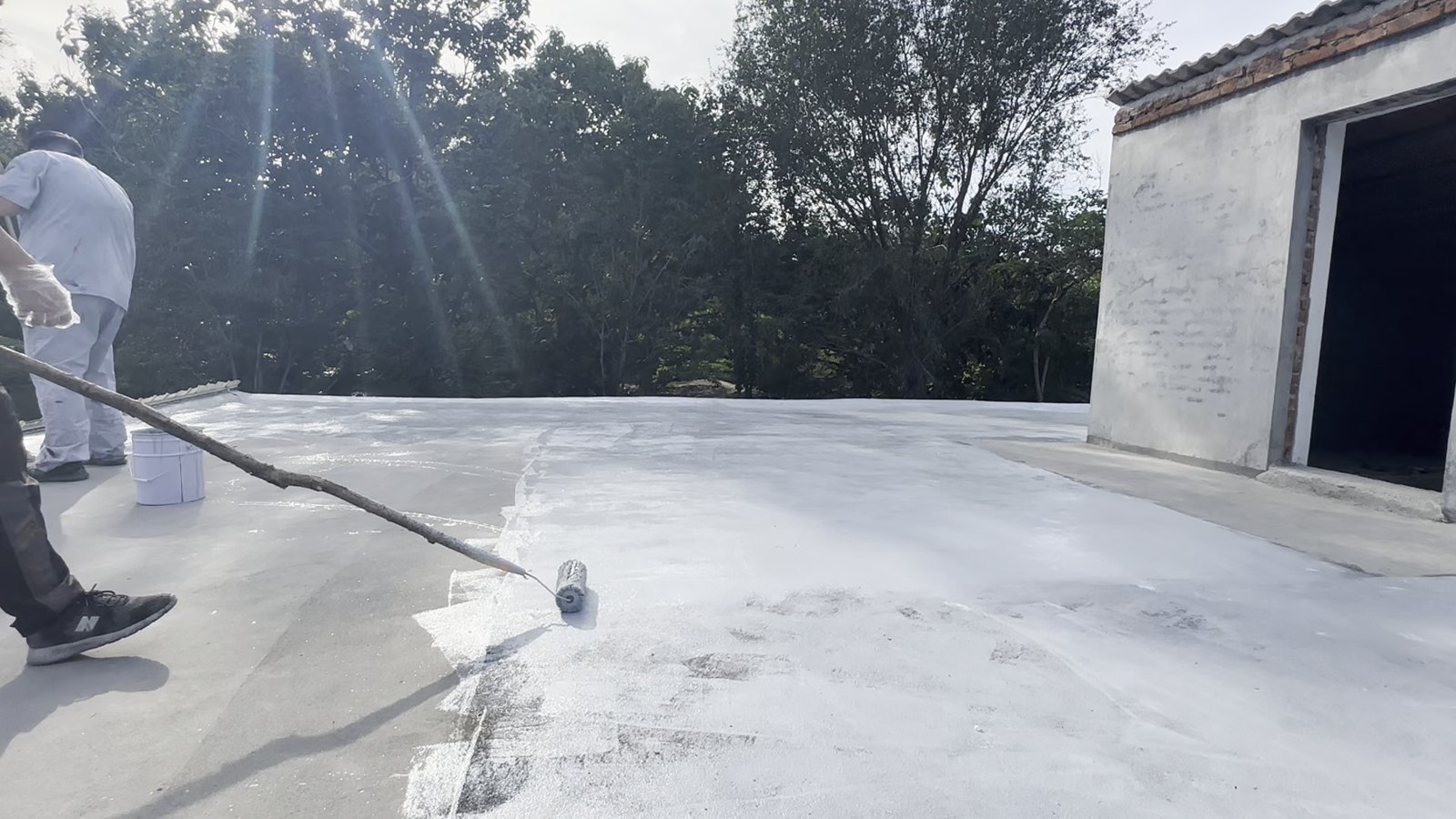
Conventional spray polyurea reacts in a few seconds, so it needs a heated plural-component spray rig and a trained crew. The polyaspartic ester reacts more slowly. Our HZ06 gives about 20 minutes of working time after mixing, which is enough to apply it with a roller or a squeegee.
“Topcoat” means it is the finish layer of a system. On site it goes over a primer that seals the substrate and gives the topcoat something to bond to.
What it is made of
Component A: the resin
Component A is mostly polyaspartic ester resin. We grind and disperse it with nano functional materials, ultrafine pigments and fillers, and additives. The pigments give the coating its color, chosen from our topcoat color chart.
Component B: the hardener
Component B is an aliphatic polyisocyanate based on HDI. Aliphatic hardeners are used in coatings that stay in the sun, because they do not turn yellow the way aromatic ones do.
The two parts are mixed 2:1 by weight. A set is 8 kg of Component A and 4 kg of Component B. Solids content is at least 95%, so almost everything in the can stays on the surface as film.
The primer
The primer depends on the substrate:
- HD400 waterborne epoxy penetrating primer for concrete, cement mortar and screed
- HD300 waterborne epoxy penetrating primer for ceramic tile, marble and paving tiles
- for metal, a compatible anti-rust primer chosen with our technical team
Both epoxy primers soak into the surface, seal the pores and anchor the topcoat.
How it works
How it cures
Once mixed, the amine groups in the resin react with the isocyanate groups in the hardener and form urea links. The film builds strength as these links grow into a dense network. In an independent lab test in January 2026, HZ06 was dry to the touch in 3 hours and hard dry in 24 hours. The test was run to GB/T 22374-2018, and the coating met the standard’s Type W requirements for container state, film appearance, drying time and initial flow (188 mm against a minimum of 140 mm).
How it keeps water out
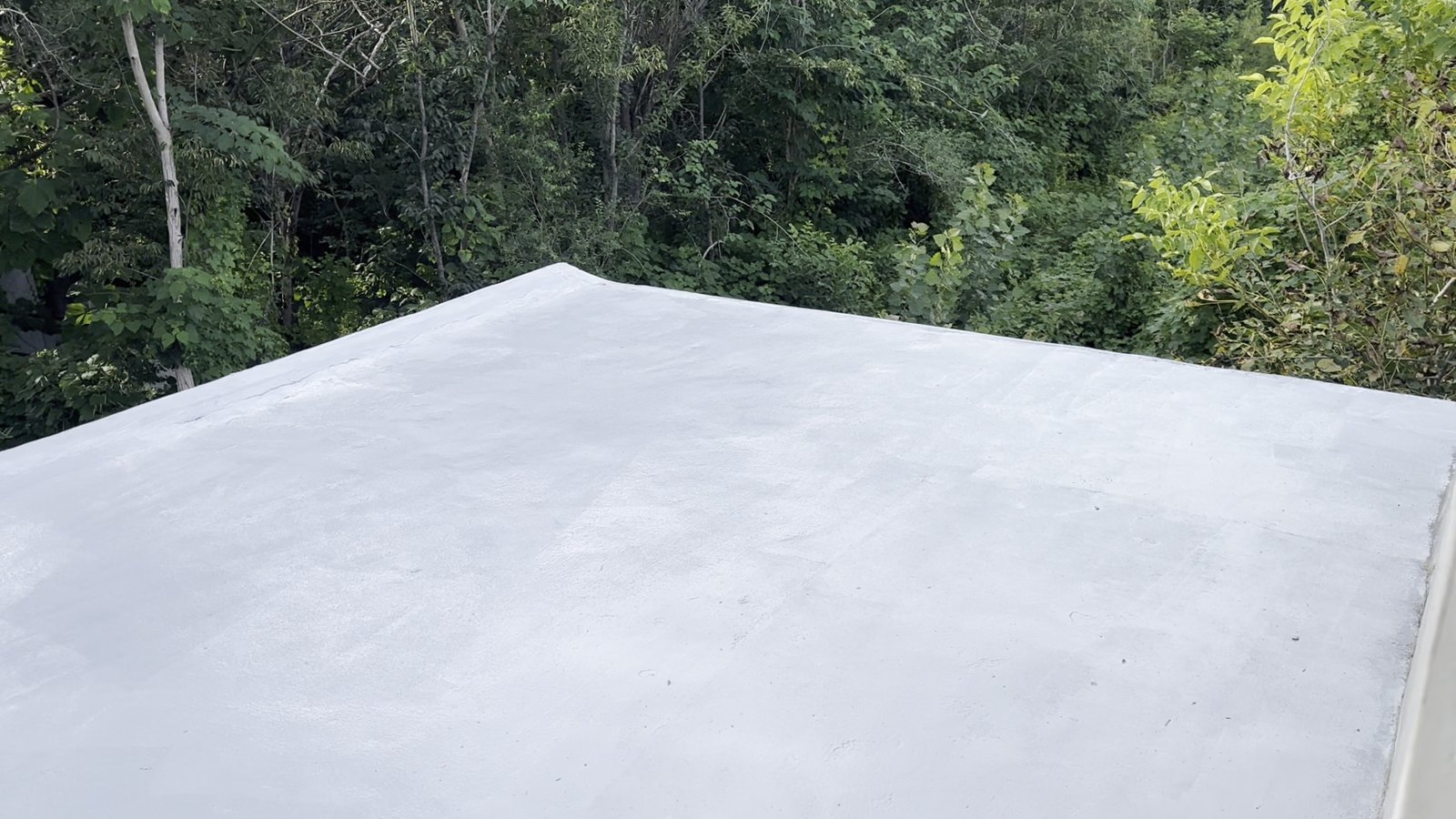
Water gets into a building through gaps. A rolled or squeegeed topcoat has no seams, laps or fixings, and it follows corners, upstands and drains. Under it, the penetrating primer bonds the film to the substrate, so water cannot track along the interface. In standard tests the cured film showed no blistering or peeling after 168 hours in water and no change after 48 hours in alkali, and its adhesion was rated grade 0 to 1.
How it handles movement and wear
Roofs and pools move with heat, cold and load. The cured film reaches Shore D70 hardness, so it stands up to foot traffic and scuffing. It also passes a 50 kg·cm impact test and bends over a mandrel of 2 mm or less without cracking, which lets it follow small movements in the substrate.
How it holds up in the sun
Because the hardener is aliphatic, the film resists yellowing and keeps its color outdoors. Aromatic polyurea and most epoxy coatings tend to yellow or chalk in direct sun, so polyaspartic coatings are the usual choice for exposed roofs and pool surrounds.
Where it is used
As a polyaspartic waterproof coating, HZ06 is used wherever a surface needs long-term protection from water:
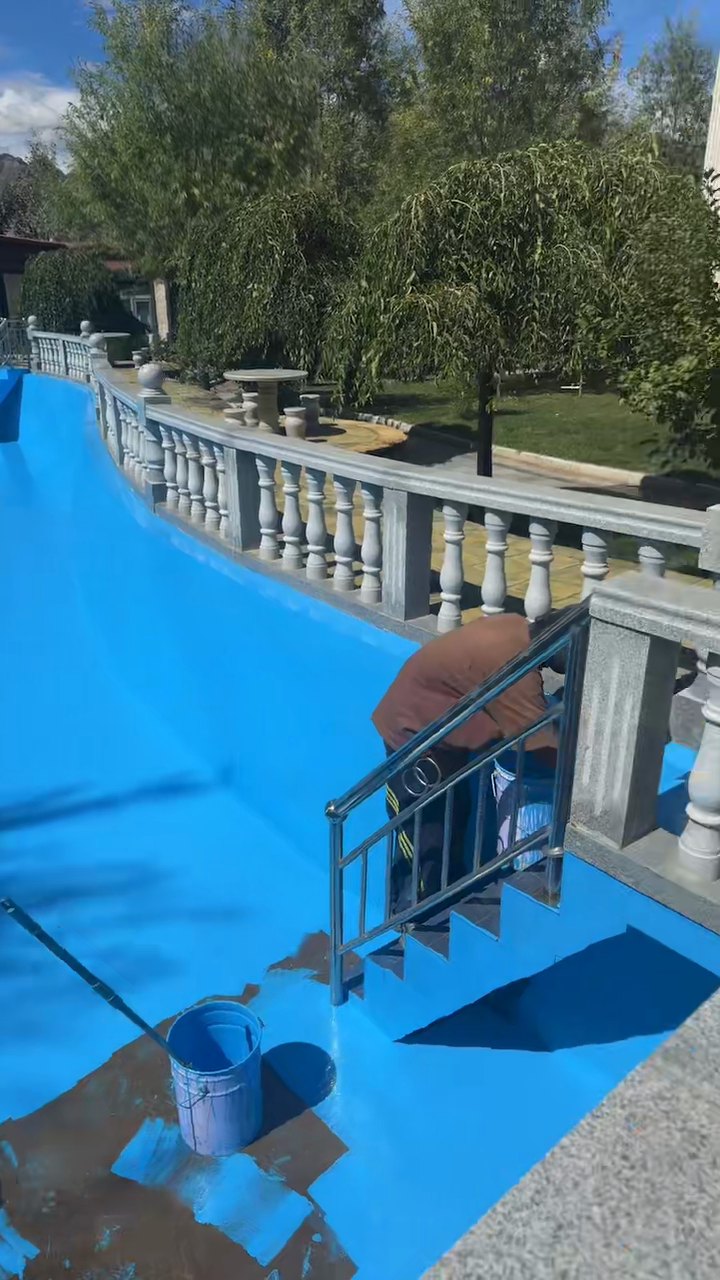
- swimming pools
- flat concrete roofs and balconies
- bathrooms and shower areas
- renovation over existing ceramic tile, marble or paving, without removing the old surface
- metal surfaces that need corrosion and rust protection
See our waterproofing and weather-resistant protection solutions for complete systems by application.
Technical data
| Property | HZ06 value | Test method |
|---|---|---|
| Mix ratio (A:B, by weight) | 2:1 | – |
| Working time after mixing | about 20 min | – |
| Solids content | ≥ 95% | GB/T 1725-2007 |
| Fineness | ≤ 30 μm | GB/T 6753.1-2007 |
| Gloss (60°) | 50–70 | GB/T 9754-2007 |
| Hardness (fully cured) | Shore D70 | GB/T 531.1-2008 |
| Impact resistance | 50 kg·cm | GB/T 1732-93 |
| Bend test | ≤ 2 mm | GB/T 6742-2007 |
| Adhesion | Grade 0–1 | GB 1720-79 (89) |
| Alkali resistance | No change after 48 h | GB/T 9265-2009 |
| Water resistance | No blistering or peeling after 168 h | GB/T 1733-1993 |
| Surface dry / hard dry | 3 h / 24 h (independent test) | GB/T 22374-2018 |
| Initial flow | 188 mm (independent test) | GB/T 22374-2018 |
| Coverage | 0.5 kg/m² (2 roller coats) or 0.35 kg/m² (1 squeegee coat) | – |
| Shelf life | 6 months sealed, 5–35 °C | – |
How it is applied
- Grind, repair and level the substrate. It must be flat, dry and clean, with no chalking, oil or standing water.
- Roll on one coat of HD400 or HD300 primer at about 0.1 kg/m². Wait 2 to 4 hours until it is dry and no longer tacky underfoot.
- Mix Component B into Component A with an electric mixer for 10 to 30 seconds. Use the mix within 20 minutes.
- Apply the topcoat by roller in two coats (about 0.5 kg/m² in total, 2 to 4 hours apart) or by squeegee in one coat (about 0.35 kg/m²).
- Keep people, heavy objects and rain off the surface for at least 24 hours. In winter, allow 1 to 2 days.
The substrate must be dry. The film is so watertight that moisture trapped underneath can push it up into blisters, so do not coat a damp surface or work in the rain, and keep water off the topcoat until it has cured. Indoors, the odor clears in 3 to 5 days with ventilation.
Get a system recommendation
Send us the area, the substrate (concrete, tile, marble or metal), what the surface is used for and where the project is. We will reply with the right primer and topcoat, the quantities and a quote. You can also order a sample kit to test on a small area first. Full specifications are on the HZ06 polyaspartic waterproof topcoat product page.
Ahonesty | WhatsApp: +853 6649 6268 | Email: shawn@ahonestymaterial.com